⭐ Built in Studio
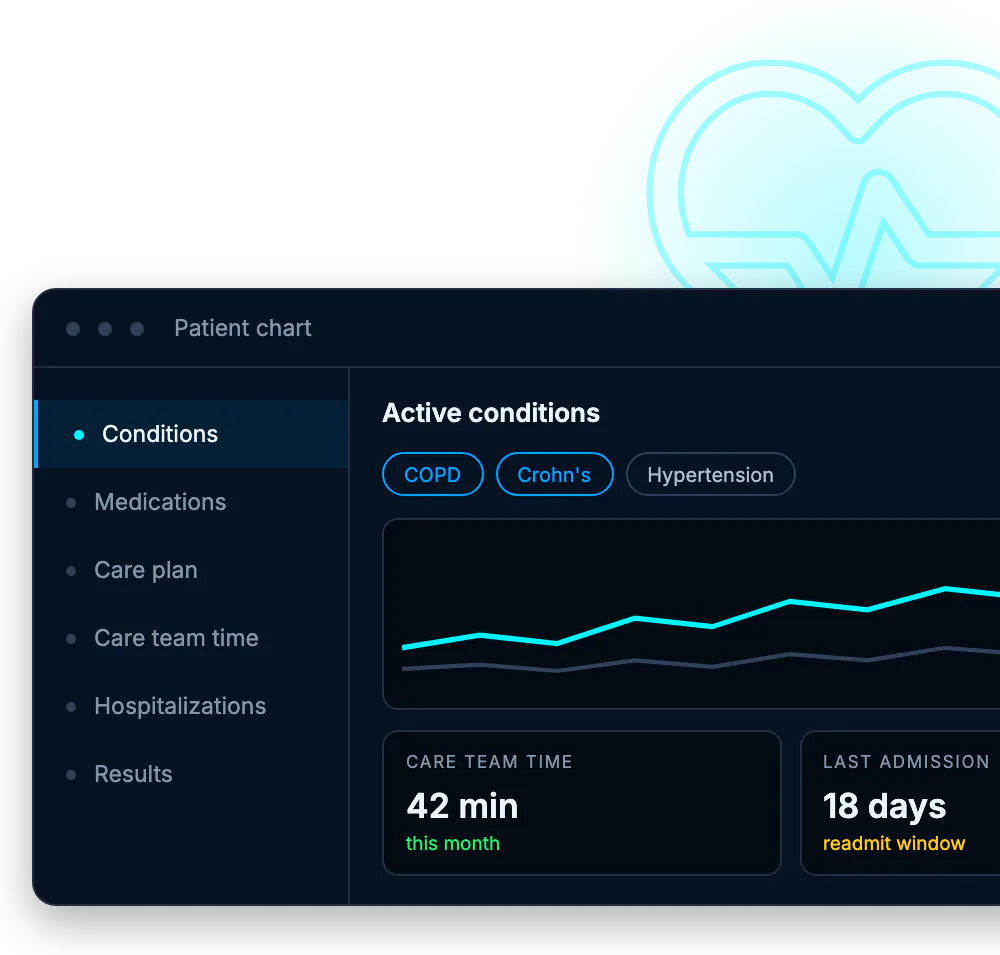
Every active condition, its measures, and its medications on one chart, so a drug for one is visible against the other two.
Calls, refills, and specialist notes logged to the patient as they happen, between visits that are months apart.
Minutes counted against CCM codes 99490 and 99439, with the documentation already attached to the claim.
How a chronic care program runs on Canvas, and how the EMR options for CCM compare.
 EMR Guide
What it takes to care for someone carrying three conditions at once, where the work between visits actually goes, and what changes when all of it lives in one record.
Read the guide Compare EMRs
Most CCM software is a second platform beside the EMR you already run. Here is what that costs you, how the ambulatory EMRs compare, and the questions worth asking before you sign.
Read the guide
A1c, medications, and CGM data trend together in one place, so the care team can see where a patient sits against goal without opening three tabs.

Home blood pressure readings arrive as structured data, and the CPT-II coding runs off the reading rather than off a manual chart review.

Symptom scores, exacerbation history, and inhaler adherence track together across months of management.

Staging, labs, and medication adjustments follow the patient, so a change in kidney function is visible when it happens rather than at the next annual.

Screening, treatment, and follow-up run on the same longitudinal record as everything else the patient is managing.

Most CCM patients carry several of these at once, and the chart is built to hold all of them rather than treating one as primary and the rest as history.
Describe the tracking, outreach, or coordination workflow you need in plain language, and Studio writes it, tests it, and deploys it to your own instance.
Weight, BMI, and blood pressure across the whole panel, filtered by age, sex, and date range, with a distribution and a monthly trend.
Inpatient stays captured as structured data: dates, reason, ICU stay, disposition, and whether it was a readmission inside thirty days, with the history on the chart summary.
Each scored instrument with its latest value, the change since last time, and how long it has been. Any trend drops into a note in one click.
A timer on the chart records each session with its activity and minutes, a banner carries the running monthly total, and a monthly sweep files the claim.
Practices running chronic care management as a program, including primary care groups, value-based organizations, and virtual-first practices managing patients with several chronic conditions at once. It fits a single practice enrolling a few hundred patients and a multi-site group running the program across every panel.
Time accrues against the patient as the work happens, across calls, messages, and coordination. The monthly total stays visible while there is still time to act on it, rather than being reconstructed from notes at billing time.
Time thresholds map to the CCM codes and the claim goes out with its supporting documentation attached. CMS requirements change year to year, so confirm the current rules against the year you are billing.
Program eligibility, consent, and enrollment live on the patient record, so a patient in more than one program shows up that way instead of being counted twice.
This is the main reason practices with an unusual care model choose Canvas. Describe the workflow you need in Studio and it gets built, tested, and deployed to your instance, or build directly on the Canvas SDK if your team would rather work in code.
Discover what a care management platform is, its key features, & how to choose one. See how Canvas enables FHIR API integration, automation, and EMR workflows.
Read the guide
Discover how remote patient monitoring improves chronic disease management, offering real-time insights and empowering proactive healthcare
Read the guide
Learn how to communicate effectively with patients using proven strategies such as teach-back, plain language, and shared decision-making for stronger care.
Read the guideOpen the chronic care trial EMR and look at Min Kang, sixty, managing COPD and Crohn's disease at the same time. Five demo patients are loaded, each carrying several conditions.


Care for patients who have several conditions at once, with the whole picture in one record. Shape the workflow to the way your practice already runs.