Most software was not built for chronic care. A patient with COPD and Crohn's disease, or diabetes alongside heart disease, does not fit a chart organized around one primary diagnosis. Most of the work happens between visits, spread across phone calls, portal messages, and coordination that no visit code covers.
The evidence often arrives from everywhere at once: labs from one specialist, imaging from another, home readings from a device, a discharge summary nobody has reconciled yet.
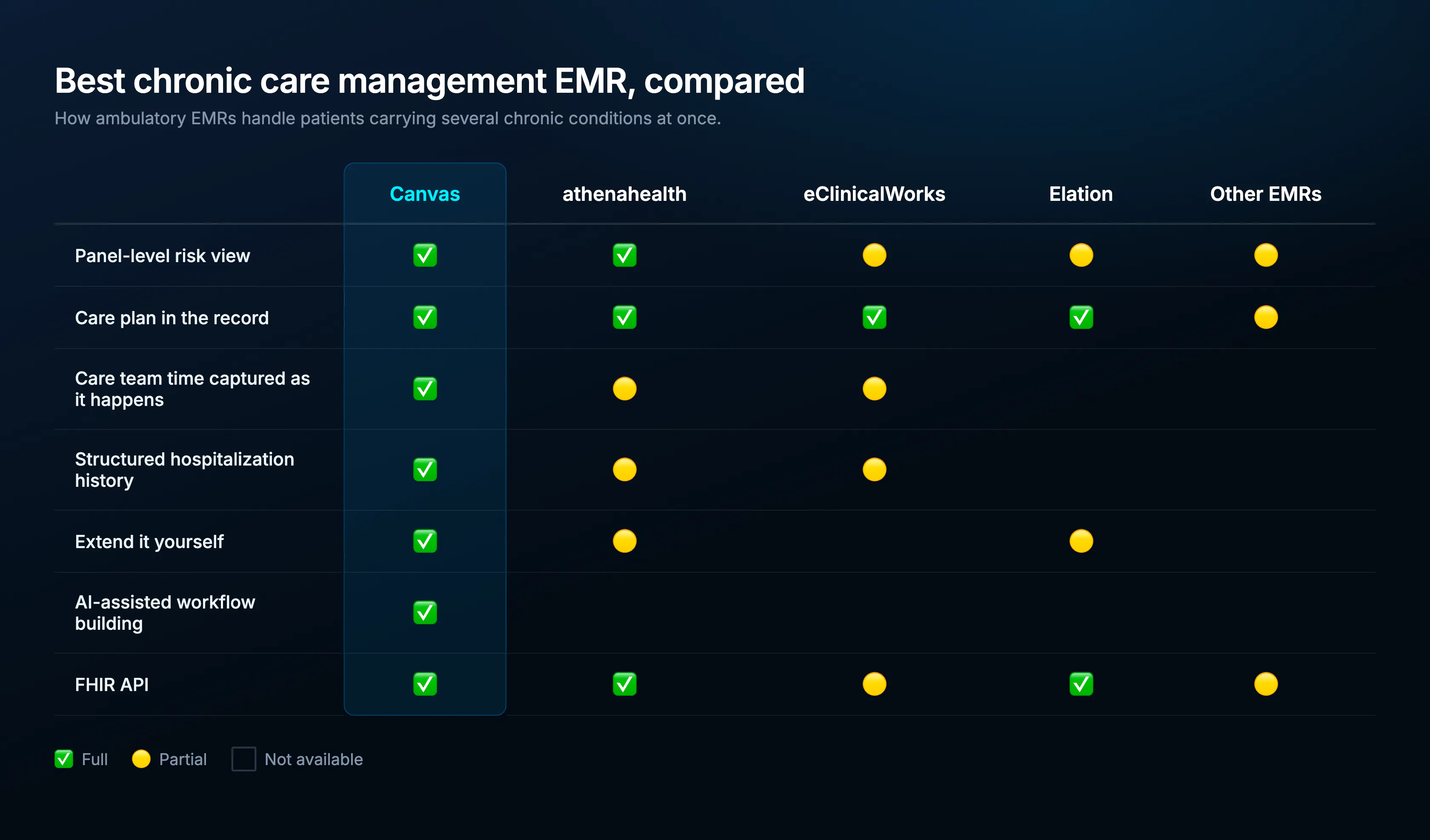
The market splits into groups that each solve part of the problem. Full ambulatory EMRs like athenahealth and eClinicalWorks carry deep registry and care plan tooling built for large primary care organizations, and they are usually the most complete out of the box. Elation sits in a lighter lane built around independent primary care. Care management point solutions handle enrollment, time tracking, and the billing paperwork in their own platform, then sync back to whatever record you run, which leaves you with two systems.
What a chronic care practice needs
- A panel-level risk view, so data is viewable on a single screen rather than one chart at a time.
- A care plan that lives in the record as a working document the whole team edits, not a static form generated to merely satisfy a requirement.
- Care team time captured as the work happens, because a system that depends on someone remembering to start a timer will undercount.
- Hospitalization history as structured data, since for a multi-condition patient an admission for one condition is usually a signal about the others.
- Instruments captured as discrete scored data, because the clinical question is almost always how the score moved since last time.
- Room to change the workflow, since most programs get modified in the first six months once the team learns what it actually needs.
- A FHIR API that reads and writes, because remote monitoring devices, discharge feeds, and payer risk files all have to reach the record.
How the platforms compare
Where Canvas is different for chronic care
The table shows where the platforms land. What it cannot show is why the gaps exist, which comes down to what each system lets a practice change.
The work between visits leaves a trace. Care team time accrues against the patient record as the work happens rather than being reconstructed at billing time, so the monthly total is a running number. That matters less for the billing than for the handoff: work with no trace cannot be given to anyone else, so the next person to pick up that patient starts from scratch and the patient explains it again.
The panel is queryable, not just chartable. Weight, BMI, and blood pressure can be read across every enrolled patient with a distribution and a monthly trend. Inpatient stays are captured as structured data covering admission and discharge dates, reason, ICU stay, disposition, and whether it was a readmission within thirty days (what makes a pattern of readmissions visible rather than buried in progress notes).
Logic can be written against what is already in the chart. Most platforms capture the data and stop there. A home blood pressure reading that stays high for two weeks can raise an alert, a medication started in the last ninety days can be checked against another active condition, and a score crossing a threshold can open another instrument or create a task. On Canvas, those are running plugins rather than features waiting on a vendor release.
How to evaluate a chronic care EMR
- Can you see the panel view in the demo, and is it a screen the team works from or a report someone requests?
- Where does time capture happen in the workflow, and does anyone have to remember to start it?
- Is the monthly total a running number, or is it reconstructed at billing time?
- Are hospitalizations queryable, or does a discharge summary land as text in a progress note?
- Who edits the care plan between visits, and can the patient see it?
- When the program changes in six months, is that a support ticket, a roadmap request, or something the practice can do?
- Which FHIR resources are supported, and are writes included or is it read-only?
- What is the total monthly cost with everything the practice actually needs turned on?
Build your own
No two chronic care practices coordinate, measure, and follow up the same way. One runs a dedicated coordination team while another spreads the work across every clinician. One bills Medicare CCM while another operates inside a value-based contract or takes cash pay for nearly identical clinical work. Ship one chronic care module and you have forced all of them into a shape that fits none of them. With Studio, built on CPA (Claude Plugin Assistant), a team describes the workflow it needs and gets a working plugin back, and anything Studio produces can be extended in code on the Canvas SDK.
One honest caveat: adopting Canvas means moving EMRs, which is a much larger project than buying a tool that connects to the one you have. If you are not moving this year, a care management point solution is the faster path, and it is the right call for plenty of practices.
Canvas is HITRUST Certified, ONC Certified, HIPAA compliant, and was named Best in KLAS 2026 for Specialty EMR.
If you want the full picture of how a chronic care practice runs on Canvas, read the chronic care management guide, or run the chronic care trial EMR and see how it feels.