Prescriber-led psychiatry runs a workflow most software was not built for. Evaluations are long and narrative rather than templated. A meaningful share of the prescribing involves scheduled medications, which pulls in electronic prescribing of controlled substances and a state database check before the script goes out. Rating scales get administered over and over, and their value comes from the trend line rather than any single score.
The market splits into groups that each solve part of the problem. Psychiatry-native EMRs like Valant and ICANotes have spent years building prescribing and documentation depth, and they are usually the deepest out of the box. Osmind sits in a narrower lane built around interventional psychiatry and measurement. SimplePractice has the largest install base in behavioral health, but it was built for therapists, and prescribing arrives as paid add-ons. Developer platforms like Medplum can build anything and ship nothing psychiatric by default.
What a psychiatric practice needs
- Controlled substance prescribing a real practice can operate, covering Schedule II through V with enrollment for every prescriber and a defensible record that the state database was consulted.
- Delegation and licensure rules that hold up, so the right person signs for the right prescriber and no script routes to a pharmacy in a state where nobody is licensed.
- Validated instruments captured as discrete scored data, because the clinical question is almost always how the score moved since last visit.
- Screening that escalates on its own, so a positive short-form result opens the long form without the clinician going to find it.
- Risk screening and safety planning encoded in the workflow rather than left to recall.
- Documentation that tolerates a long narrative evaluation and a mental status exam.
- Time-based coding support, since psychiatric evaluation and psychotherapy add-on codes turn on documented time.
- For interventional practices, monitoring during and after in-clinic treatment.
How the platforms compare
Where Canvas is different for psychiatry
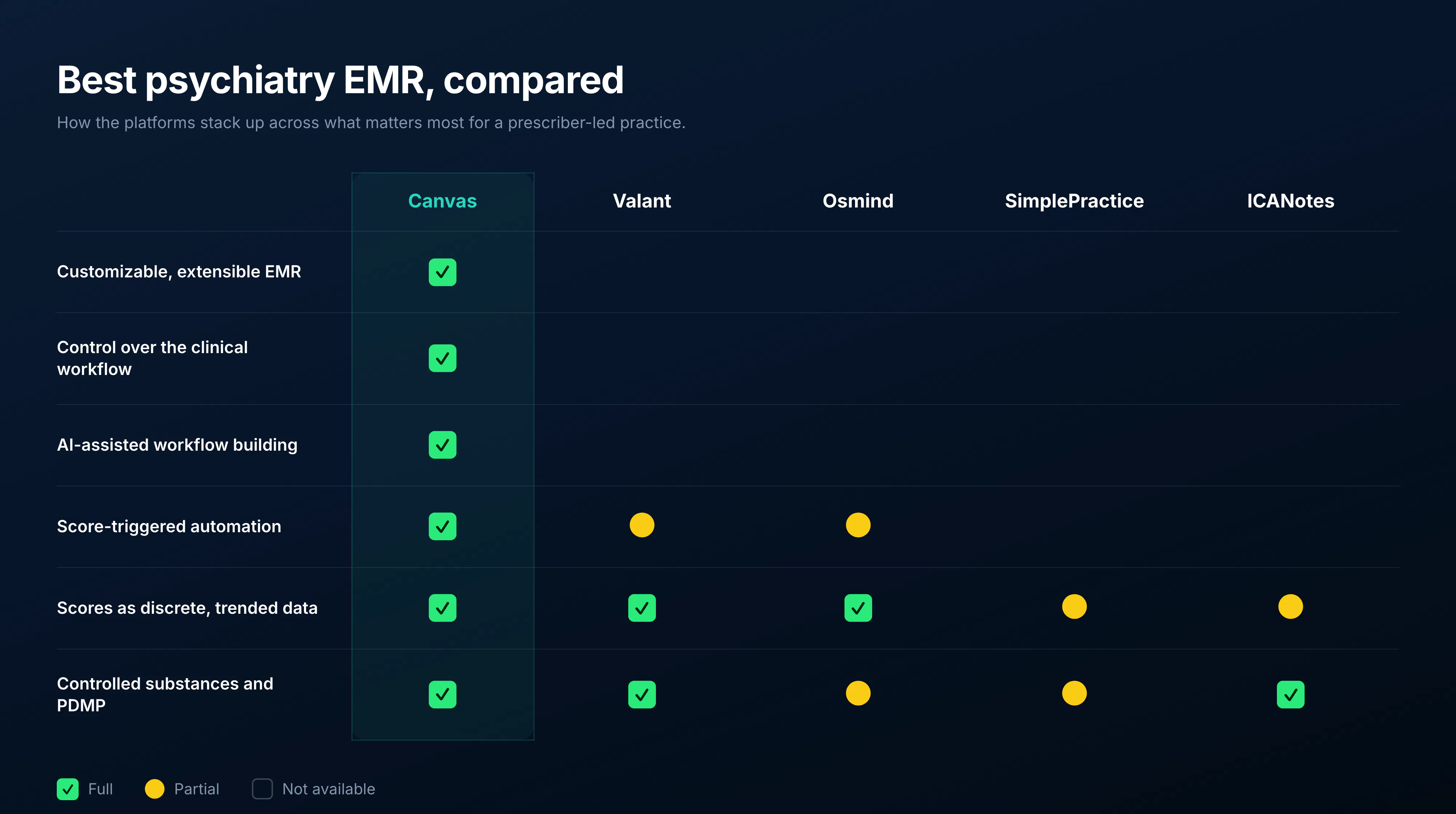
The table shows where the platforms land. What it cannot show is why the gaps exist, which comes down to what each system lets a practice change.
Most platforms capture the data and stop there. Valant and Osmind both store scores as structured data and chart them over time, and those are real capabilities. What none of them offer is the ability to write logic against what is already in the chart. A score crossing a threshold can open another instrument or create a task, a prescription for a scheduled medication can enforce who is allowed to sign it and where it can be sent, and an antipsychotic can carry its own monitoring protocol. On Canvas those are running plugins in the public repository rather than features waiting on a vendor release.
Instruments are data, not forms. Scores are coded and scored server-side, stored as discrete per-question responses, and queryable, which is what makes trending and score-triggered automation possible in the first place. Canvas ships a core set built in, including PHQ-2, PHQ-9, GAD-2, GAD-7, and AUDIT-C, with more available as installable plugins. If your practice needs an instrument that is not in either set, we add it and it is scored and LOINC-coded like everything else.
How to evaluate a psychiatry EMR
- Which schedules can prescribers send, and what does enrollment require of each one, including identity proofing and token setup?
- Which gateway powers the PDMP integration, and where can the current state list be checked?
- Where does the check happen in the workflow, and how is it documented afterward?
- Are scores discrete queryable data, and can something happen automatically when one crosses a threshold?
- Which instruments ship, and what does adding one that does not require?
- Can documentation hold a long narrative evaluation and a mental status exam without fighting a template built for another specialty?
- What is the total monthly cost for one prescriber with everything the practice actually needs turned on?
Build your own
No two psychiatric practices measure, prescribe, and follow up the same way. A practice built around ADHD care needs different instruments and a different controlled substance rhythm than one built around treatment-resistant depression. With Studio, built on CPA (Claude Plugin Assistant), a team describes the workflow it needs and gets a working plugin back, and anything Studio produces can be extended in code on the Canvas SDK.
If you want the full picture of how a psychiatric practice runs on Canvas, read the psychiatry EMR guide, or run the psychiatric trial EMR and see how it feels.