More than one in five American adults lives with a mental illness, and most of that care is delivered outside a hospital by prescribers who manage medication over months and years. Those practices run a workflow that looks almost nothing like the fifteen-minute primary care visit most clinical software was designed around. The evaluations are long and narrative, a large share of the prescribing is controlled, and the clinical question at nearly every follow-up is whether a number moved since last time.
This guide covers what outpatient psychiatric care involves, how prescribers run evaluation and medication management, and what changes when a practice has real control over its workflow.
What Is Outpatient Psychiatric Care?
Outpatient psychiatric care is the diagnosis and ongoing treatment of mental health conditions by a prescriber, delivered without an overnight stay. A psychiatrist or psychiatric mental health nurse practitioner evaluates the patient, arrives at a diagnosis, prescribes and adjusts medication, monitors response with validated instruments, and manages risk over the course of the relationship.
The conditions cluster into a handful of categories that account for most of the volume:
- Major depressive disorder, where measurement drives most treatment decisions
- Anxiety disorders, which frequently present alongside depression
- Bipolar disorder, where distinguishing a depressive episode from a hypomanic one shapes the whole treatment plan
- Schizophrenia and other psychotic disorders, which carry ongoing metabolic and laboratory monitoring
- Substance use disorders, which co-occur with all of the above
- ADHD, treated largely with scheduled medication
The work divides into two kinds of visit. The initial evaluation runs long and produces a narrative assessment covering history, mental status, risk, and a treatment plan, and it is billed differently from the evaluation a non-prescribing clinician performs. Follow-up visits are shorter and focus on how the patient responded, whether the dose needs to change, and whether anything has become unsafe.
Why Psychiatric Care Is Hard to Run on General Software
Three characteristics of the specialty collide with software built for other kinds of medicine.
Controlled substances are routine rather than exceptional. Stimulants for ADHD, benzodiazepines for anxiety, and several classes used in mood and sleep disorders are all scheduled. Electronic prescribing of controlled substances requires per-prescriber identity proofing and a hardware token under DEA rules, and most states require a check of the prescription drug monitoring program database before the script goes out. A general EMR treats that as an exception path, but for a psychiatric practice it is most of the prescribing volume.
A single score means very little. A PHQ-9 of 14 means almost nothing on its own, and it means a great deal if the last one was 21. Measurement-based care only works when instruments are administered repeatedly and the results come back as discrete data the clinician can compare against the last visit. A scanned questionnaire sitting in a document folder cannot answer the question being asked.
Documentation runs long and does not template well. A psychiatric evaluation includes a mental status exam and a narrative history that resists being compressed into a form built for a chief complaint and a physical exam. The platforms most widely used across behavioral health were designed around the therapy visit, so prescribing, controlled substance handling, and longitudinal scoring all end up bolted onto software built for a different job.
Telepsychiatry compounds all three, because a large and growing share of outpatient psychiatry is delivered virtually. That adds multi-state licensure, remote instrument administration, and prescribing to a pharmacy the patient may be nowhere near.
From First Visit to Dose Change: One Patient's Path
A 34-year-old arrives for an initial psychiatric evaluation after months of low mood, poor sleep, and difficulty concentrating. Before the visit, a short screener goes out through the patient portal. The PHQ-2 comes back positive, which opens a full PHQ-9 with the two shared answers already carried forward, so only the new questions remain. The patient completes it, and the score lands in the chart as discrete data before anyone walks into the room.
The evaluation itself runs long. The prescriber takes a history, documents a mental status exam, screens for risk, and arrives at a working diagnosis of major depressive disorder. The score is already in the note, so the conversation starts from where the patient actually is rather than from a blank form. An antidepressant is started, and the visit is documented with the time captured where billing can use it.
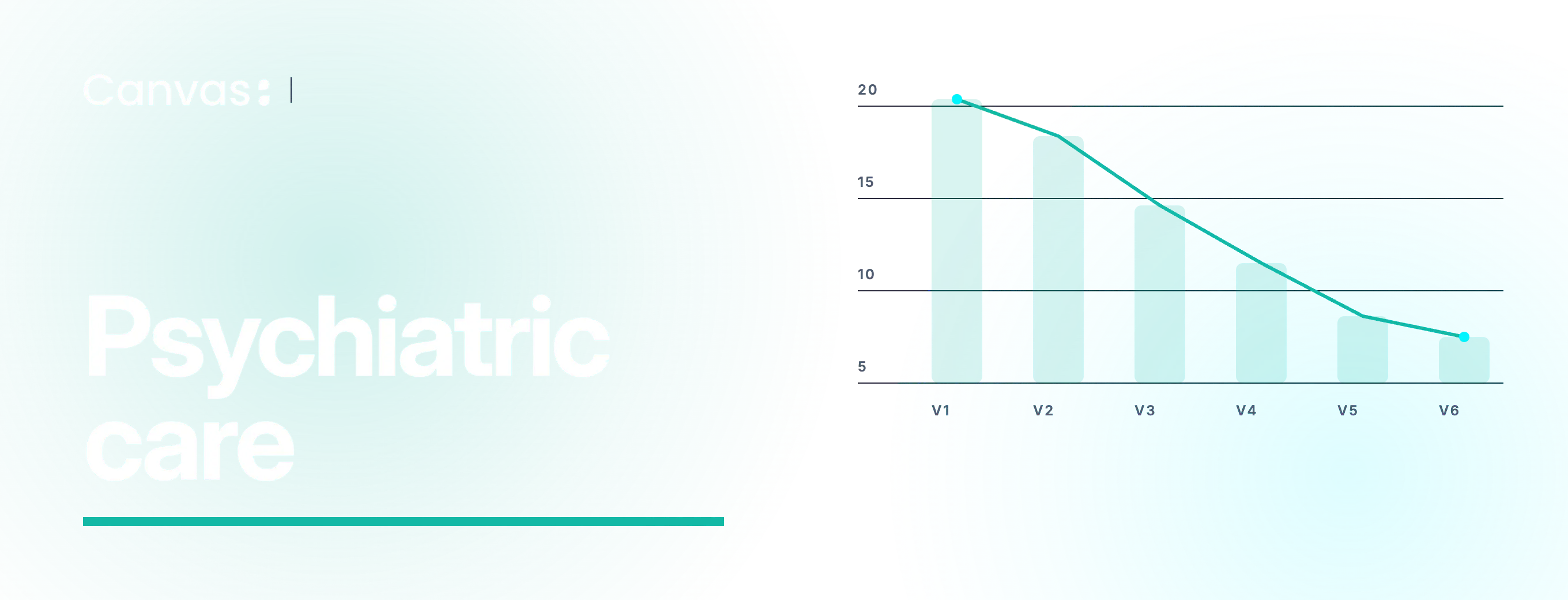
Six weeks later the patient returns, and because the therapeutic window has passed, this is the visit where the decision gets made. The prescriber opens the chart and sees the new PHQ-9 against the first one on a trend line rather than hunting through prior notes. The score has moved but not enough, so the dose goes up and the follow-up interval is set.
By the next visit the score has come down and held. Each of those decisions was possible because the score existed as data every time, comparable to the one before it, which only happens when the instrument reaches the patient on schedule and the result lands somewhere a clinician can chart.
Canvas: A Programmable Platform for Psychiatry
At Canvas we have built a programmable care modeling platform rather than a fixed EMR, and in psychiatry the difference shows up in what happens after the data exists.
Capturing a PHQ-9 as structured data is not a differentiator, since the established psychiatry EMRs do it, chart it over time, and ship large instrument libraries on day one. What a programmable platform adds is the ability to write logic against what is already in the chart. A score crossing a threshold can open another instrument or create a task, a prescription for a scheduled medication can enforce who is allowed to sign it and where it can be sent, and an antipsychotic can carry its own monitoring protocol. None of that waits for a vendor to add the feature.
That rests on a few named pieces:
- The Canvas SDK is where builders extend and customize the platform, adding commands, questionnaires, chart sections, and automations.
- Plugins package that work into installable capabilities a practice turns on.
- Studio, built on CPA (Claude Plugin Assistant), powered by Claude Code, lets a team describe the workflow it needs and get a working plugin back.
Canvas ships a core set of instruments built in, including PHQ-2, PHQ-9, GAD-2, GAD-7, and AUDIT-C, with more available as installable plugins. If your practice needs an instrument that is not in either set, we add it and it is scored and LOINC-coded like everything else.
How You Can Run a Psychiatric Practice With Canvas
Every capability below is a plugin running in production today.
Stepped screening
A PHQ-2 committed above threshold originates a full PHQ-9 in the same note and carries forward the answers the two instruments share, so the clinician fills in only what is new. The same pattern runs from PHQ-9 to MADRS, and the scored interpretation is written back into the note.
Risk alerting on the instrument
A PHQ-9 scoring 20 or above, or any positive response to question nine, raises an alert and creates a task rather than depending on the clinician to notice the number.
Scores charted over time
A scoring dashboard charts results from scored questionnaires on a trends tab, and a clinician can insert any trend straight into the note. Scores are stored as coded discrete data with server-side scoring, which is what makes them queryable rather than trapped in a completed form.
Instruments delivered to the patient
A portal forms plugin assigns questionnaires ahead of a visit, and submissions land in the chart as structured data. Practices that tie measurement to a treatment session rather than to an appointment use this to make sure the score is there before the patient arrives.
Controlled substance prescribing
Canvas supports electronic prescribing for Schedule II through V through DrFirst over Surescripts, and integrates with the Bamboo Health PMP Gateway so a prescriber runs the state database check from the note and the result is documented in the record. A prescriber filter plugin controls which users may sign for which prescriber, and it blocks a prescription from routing to a pharmacy in a state where nobody on the team holds a license.
In-clinic treatment programs
For practices delivering transcranial magnetic stimulation, esketamine, and similar interventions, device vitals stream into the chart with windowed averages computed at timed marks and written back as coded observations. Measurement in these programs is usually tied to the session rather than to a follow-up appointment, which means the instrument has to reach the patient before treatment begins.
Building Your Own Psychiatric Workflow with Studio
No two psychiatric practices measure, prescribe, and follow up the same way. A practice built around ADHD care needs different instruments and a different controlled substance rhythm than one built around treatment-resistant depression. Because Canvas is programmable, those differences become plugins rather than custom software projects.
With Studio, a team describes what it needs, whether that is an instrument that does not ship, a score wired to an automated protocol, or a titration protocol specific to how the practice dose-adjusts, and gets a working plugin back. Studio sits on the Canvas SDK, so anything it produces can be extended in code.
Why This Works
For prescribers, the score is already in the note and the follow-up instrument opens itself, so the administrative work around measurement stops competing with the clinical conversation. For patients, instruments arrive before the visit rather than on a clipboard in a waiting room, and the trend becomes something a clinician can show them on screen. For practices working across state lines, the prescribing rules are enforced by the software rather than carried in someone's memory.
Run a Psychiatric Practice on Canvas
The fastest way to evaluate any of this is inside a working chart. The Canvas psychiatric trial instance runs every workflow described here, and our guide to choosing a psychiatry EMR compares the major platforms on prescribing, measurement, and how far each one lets a practice extend and customize the workflow.
Frequently Asked Questions
What is the difference between psychiatry and therapy?
Psychiatrists and psychiatric mental health nurse practitioners are prescribers who diagnose mental health conditions and manage medication. Therapists and counselors provide talk therapy and generally do not prescribe. Many patients see both, and the two roles use some of the same instruments while asking different questions of the results.
What is measurement-based care in psychiatry?
Measurement-based care means administering validated instruments such as the PHQ-9 or GAD-7 on a regular schedule and using the results to guide treatment decisions rather than relying on clinical impression alone. It works only when scores are captured as discrete data that can be compared over time.
What does EPCS mean, and do psychiatrists need it?
EPCS stands for electronic prescribing of controlled substances. Most psychiatric practices need it, because stimulants, benzodiazepines, and several other commonly prescribed psychiatric medications are scheduled. Enrollment requires identity proofing and two-factor hardware authentication under DEA rules.
What is a PDMP check?
A prescription drug monitoring program is a state database of controlled substance prescriptions. Most states require a prescriber to consult it before prescribing a controlled substance, and many require the check to be documented. Canvas integrates with the Bamboo Health PMP Gateway so the check runs from the note and the result is documented in the record.
Can psychiatric care be delivered virtually?
Yes, and a large share of outpatient psychiatry now is. The examination is primarily conversational, which adapted well to video. The complications are administrative rather than clinical, including multi-state licensure, remote instrument administration, and pharmacy routing across state lines.
Can an EMR be customized for a psychiatric practice?
On most platforms, customization means configuration within what the vendor built. On a programmable platform, a practice can add instruments, wire a score to an automated action, and change how a workflow runs without waiting for a vendor release.