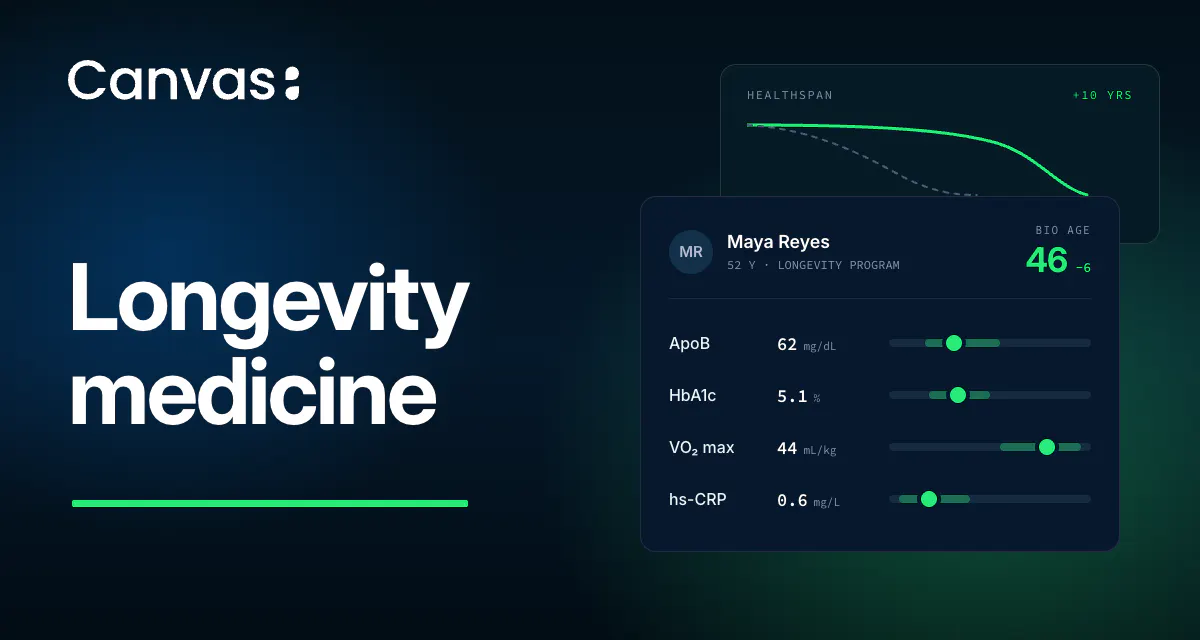
Americans spend an average of 12.4 years of life in poor health, the widest healthspan-lifespan gap of any of the 183 countries the World Health Organization tracks. Lifespan climbed through the last century while the years people spend in good health fell behind it.
Longevity medicine responds to that gap with preventive care organized around healthspan, the years a person lives in good health. Practices measure the processes that drive aging while a patient still feels fine and intervene early enough to change the trajectory.
These practices also go by preventive medicine, healthspan medicine, or precision preventive care, and most are a membership or cash-pay model. Their patients usually arrive without a diagnosis, so a diagnosis-driven EMR has no problem list to organize the chart around. The clinical value sits in how dozens of measures move over years.
The people joining these practices usually arrive with goals: steadier energy, a stronger libido, better athletic performance, sharper cognition, weight and inflammation under control. The baseline panels and follow-up protocols below are how a practice answers that list.
The clinical logic starts with where American mortality comes from. Chronic diseases such as heart disease, cancer, and diabetes are the leading causes of death and disability in the United States and develop across decades of measurable change before symptoms bring someone to a doctor. Longevity medicine treats those symptom-free decades as the time to intervene.
A few distinctions shape how a longevity practice runs:
- Cosmetic anti-aging is a different field. The clinical target in longevity medicine is how well a patient functions and how many years they stay free of disease.
- Primary care stays in the picture. Many longevity practices coordinate with a patient's existing primary care physician, with some positioning themselves as consultants to that physician.
- Protocols vary from one practice to the next. Practices differ in which biomarkers they track, which interventions they favor, and how aggressively they treat results that sit inside conventional reference ranges but outside optimal ones.
Longevity medicine also starts earlier than medical weight management or chronic care management, both of which work with patients who already have a diagnosis.
Why Longevity Medicine Matters
The clinical case for Longevity Medicine rests on measures with strong evidence behind them that a routine physical often skips. Cardiorespiratory fitness and lipid testing are two of the clearest examples.
Start with cardiorespiratory fitness. In a cohort of 122,007 patients undergoing treadmill testing, fitness was inversely associated with all-cause mortality with no observed upper limit of benefit. The difference between the least fit and most fit groups exceeded the mortality risk associated with coronary artery disease, diabetes, and smoking. A routine physical does not include a VO2 max test, so longevity practices run one themselves.
Lipid testing shows the same gap between the evidence and routine care. ApoB directly measures atherogenic particle count and predicts cardiovascular risk better than standard LDL cholesterol when the two disagree. European guidelines prefer it for patients with high triglycerides, diabetes, or obesity. The European Atherosclerosis Society recommends measuring Lp(a) at least once in every adult, yet ApoB and Lp(a) together account for less than 1% of US lipid testing.
How Longevity Practices Measure and Manage Healthspan
Most longevity practices run a version of the same care model, though the specific panels and protocols vary widely.
- It starts with a comprehensive baseline. A new member workup includes an extended metabolic and lipid panel with ApoB and Lp(a), hormone panels, inflammatory markers, micronutrient status, DEXA, fitness testing, continuous glucose monitoring, and often advanced imaging or genetic screening.
- Results get scored against the practice's own ranges. A result inside the lab's reference range can still be flagged, since a reference range describes what is typical in the population the lab measured. The approach is risk stratification applied to a healthier population over a longer horizon.
- Each pattern of findings gets a protocol. Interventions span exercise, nutrition and sleep, targeted supplementation, hormone replacement, and peptide therapies where clinically indicated. Protocols are age-specific and tailored to the member's own results.
- Then the practice remeasures on a schedule. An ApoB of 95 mg/dL means little on its own and a great deal if the last draw was 130, so trending the results helps guide the intervention made in between. A panel of sixty markers drawn quarterly gives each member 240 data points a year to personalize care and build trend lines.
Canvas: A Programmable EMR for Longevity Medicine
Canvas is a programmable EMR. No single protocol governs longevity medicine, so each practice uses Canvas Studio, the AI plugin builder inside the Canvas EMR, the Canvas SDK, and a FHIR-based data layer to build the protocol logic it actually runs.
In Studio you describe the workflow you want in plain English and review the plan Studio proposes. Studio then builds the plugin, which you test in a sandbox on your instance and publish once it behaves the way your protocol does.
Lab results and vitals are held as discrete values rather than as documents. When a practice maps a specialty panel into Canvas, the results return with the lab's reference ranges.
One Patient's Path Through a Longevity Practice on Canvas
The patient in this example is illustrative: a 48-year-old man who joins a membership practice feeling well, with no diagnoses and no medications. He came in because his father had a heart attack at 58.
The baseline visit
His baseline labs come back through Canvas's connection to LabCorp and Quest by way of Health Gorilla, each result arriving as a discrete value with the lab's reference range attached. Specialty labs outside that network usually require a custom integration that should be planned during implementation.
His standard LDL is 118 mg/dL, close enough to normal that it would rarely prompt action on its own. His ApoB is nonetheless elevated relative to that LDL, and his Lp(a) is high, a genetic marker directly relevant to his family history. Two weeks of continuous glucose monitoring show marked spikes after meals even though his fasting glucose is normal. DEXA puts his visceral fat above his clinician's acceptable range despite a BMI of 26.
- The practice's thresholds are applied automatically. Canvas checks his results against the practice's own rules, which the practice built in Studio, and puts the matching protocol in front of the clinician.
- Questionnaire scores start a trend line. The Scoring Visualizer graphs any scored questionnaire over time, so the sleep, mood, and energy instruments he completes at each visit become a trend.
None of these findings is a diagnosis, but together they point toward one. His clinician builds a protocol around the pattern, with zone 2 cardio and resistance work, a nutrition plan aimed at the glucose spikes, and lipid-lowering therapy chosen for particle count rather than LDL alone.
- Prescriptions go out together. Prescription Favorites keeps a searchable catalog of the practice's most-prescribed medications and sends several in one batch, which suits hormone and supplement protocols.
- Billing runs outside insurance. Canvas has fee schedules, patient statements, and superbill output, with card payments running through its built-in Stripe processor or a custom payment processor and the SDK able to charge a stored card for recurring membership fees.
The months that follow
As the months pass, his ApoB comes down and keeps falling, his glucose variability narrows, and his visceral fat drops while lean mass holds. His Lp(a) is unchanged, as expected for a marker largely set by genetics. It stays in the record as a permanent risk factor that raises the bar for everything else.
- A dashboard shows the whole trajectory. A practice can build one in Studio that graphs any lab marker against its own thresholds and puts a member's trajectory and risk markers in one provider view, with a subset mirrored to the patient portal.
- A rising result prompts a review. An ApoB that crosses the practice's threshold puts a protocol review in front of the clinician.
Running that for a whole panel of members takes software that treats longitudinal biomarker data as the core of the record.
Building Your Own Longevity Workflow With Studio
Scoring Visualizer and Prescription Favorites come installed on the longevity trial EMR, while the dashboard and threshold rules above are built by the practice. To build a healthspan dashboard for your own marker set, start Studio with a prompt like this one:
Build a healthspan dashboard for the patient chart. Show ApoB, Lp(a), hsCRP, fasting insulin, and HbA1c as trend lines across every draw. Flag any value outside the target range our practice sets for each marker. Let us edit those ranges in settings. After a clinician reviews new results, show a simplified version of the same trends in the patient portal.
Developers who want to go further can extend anything Studio builds on the Canvas SDK.
What Changes for Practices and Members
On Canvas, the practice's thresholds and protocol logic run inside the EMR instead of in a spreadsheet kept beside it. Every member gets scored the same way and can see their own progress.
Try the Longevity Trial EMR
Start a longevity trial to work in a live instance with five demo patients, or browse the plugins library to see which plugins you can add to your own practice.