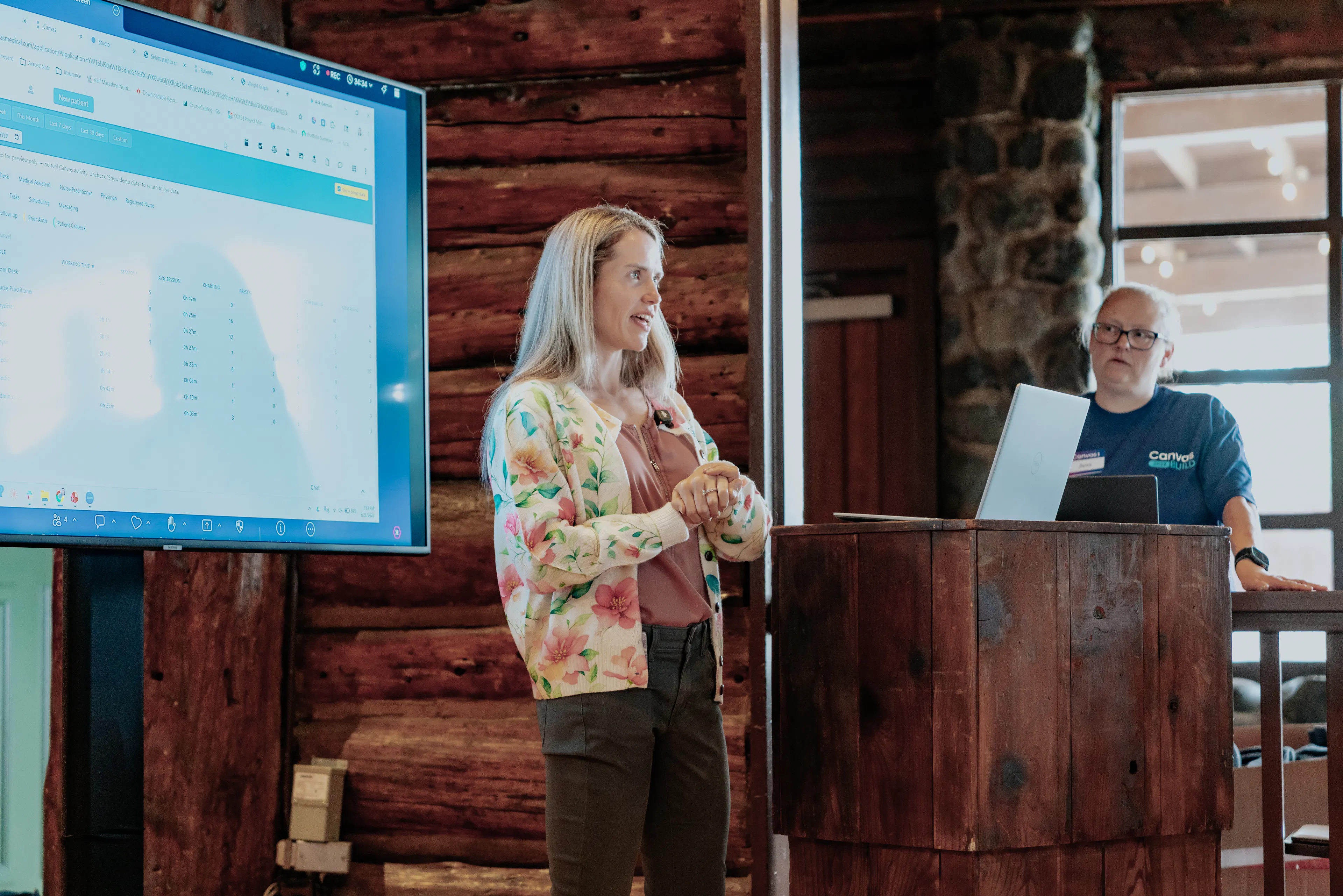
Vineyard's Summer and Amber on what they built at Canvas BUILD - and why it matters for GLP-1 care
GLP-1 medications are among the most prescribed and most closely watched drugs in medicine today. Vineyard is a virtual health clinic managing patients on these drugs, making high-stakes dosing decisions, often with incomplete data and limited ways to visualize progress. Two registered dietitians at Vineyard decided to fix that. They built the tool themselves, and it took a single afternoon.
Summer Kessel is Chief Operating Officer, responsible for managing the practice, the patient experience, and the providers at Vineyard, a fully virtual cardiometabolic and GLP-1 weight management practice serving patients across all 50 states. She will be the first to tell you she had to Google a lot of things the day she came to Canvas BUILD. She left with a working plugin.
Amber Cross, her colleague and fellow registered dietitian, is the company’s self-proclaimed Chief Swiss Army Knife. She handles a little bit of everything. She too left with a working plugin, one that she built to solve a problem she had been working around for months.
Together, they are a good illustration of what Canvas Studio was built for: people who know exactly what their patients need, and who until now had no way to build it themselves.
The problem Summer was solving
Vineyard operates on a subscription model. That means there is no fee-for-service billing data to measure provider productivity against. Summer manages a team of physicians and dietitians who she describes, with evident affection, as really smart and really busy. But she had no way to verify the second part.
"I have a hard time knowing how my team is spending their time," she explained during the BUILD showcase. "We encourage fast response times, work-life balance, in-depth video conversations with patients, and have asynchronous care pathways - a concierge-type model. And yet, as a business, we do want to ensure productivity and develop benchmarks and expectations for providers. It's a balance."
So she built a dashboard: a provider productivity tracker that pulls activity data from Canvas, including prescriptions written, notes completed, charting, and tasks, broken down by role. You can get granular insights (e.g. physicians versus dietitians, who is prescribing the most, how work hours are distributed across the team).
The problem Amber was solving
Amber's problem lives at the center of GLP-1 care: understanding whether a medication is actually working, at which dose, over time.
Vineyard's patients come in for cardiometabolic and weight management care. Their prescribers are making decisions about GLP-1 medications, including Wegovy and Zepbound, titrating doses up or down based on how patients are responding. But Canvas's standard vitals view was not built to tell that story. A list of weights does not show trends, and it does not show which medication a patient was on during which period. It does not show whether the 10-pound drop in week one was real loss or simply water weight. Amber built a visualization that captures all of that.
Her plugin pulls a patient's weight history and maps it against their prescription timeline. A patient on Wegovy, who then switched to Zepbound 2.5, who then moved to Zepbound 5, can now be seen as a continuous story. The prescriber sees the weight trend line against each medication block, with average percentage loss calculated for each period. They can see which dose was working. They can make better decisions faster.
She added two more features during the workshop. The first: an insert-to-note function, so the visualization can be dropped directly into a visit note or sent to insurance for prior authorization documentation. The second: the ability to add past weights, because patients often arrive with data that predates the visit, and the graph should reflect the full picture.
She named the test patient Testy McTestPants. The room loved it.
What this looks like from the outside
Neither Summer nor Amber would describe themselves as developers. Summer managed a practice, and Amber is a registered dietitian who had accumulated enough technical fluency to know what she wanted but not always how to build it. When the colors on Amber's weight visualization were not rendering correctly, someone in the room suggested she ask Studio for logging. She did not entirely know what logging meant, but played around with it. And it worked.
That is the point. Canvas Studio is not a tool for people who already know how to code. It is a tool for people who know their patients, their workflows, and their problems, and who can now act on that knowledge directly.
What Summer and Amber built at BUILD will go into production at Vineyard. One plugin will give operations visibility into provider performance it has never had before. The other will change how prescribers make GLP-1 dosing decisions for every patient they see. They built both of them in a single day, fairly autonomously.
Vineyard is a fully virtual cardiometabolic and GLP-1 weight management practice operating across all 50 states. Learn more at joinvineyard.com.
Canvas Studio is now live and rolling out to Canvas customers. Learn more at canvasmedical.com/studio.