Radial, a leading player in interventional psychiatry, deployed Canvas to power clinical operations across documentation, prescribing, lab ordering, and billing while delivering bespoke care experiences at scale.
- 6-week implementation completed alongside RadialOS development
- 9 plugins powering clinical documentation, prescribing, lab ordering, and billing

About
Radial is a national leader in interventional psychiatry, offering fast-acting, evidence-based treatments (like TMS and Spravato) for depression, PTSD, anxiety, and related conditions. Since its founding in 2023, Radial has raised $50 million from top VC firms, including General Catalyst, Solari Capital, JSL Health Capital, Founder Collective, and more.
Challenge
Legacy EMR Solutions Couldn’t Support Radial’s Differentiated Care Model
Radial was founded to establish the infrastructure that interventional psychiatry had always lacked, a national network of practices offering bespoke treatments to patients who had exhausted traditional approaches. However, delivering on this mission would require an EMR with capabilities most legacy solutions simply couldn’t match.
Having spent nearly two decades working at the intersection of psychiatry and technology, Radial co-founder and CPO Carlene MacMillan faced this challenge head-on. She observed how larger industry incumbents (while stable) offered no psychiatric focus and a low appetite for collaborative relationships with fast-moving startups. Conversely, niche “walled-garden” solutions controlled the UI, workflows, and data layer to such a degree that it would limit the engineering team’s flexibility in building and owning their patient-facing platform, RadialOS.
Engineering overhead was another crucial consideration here. While Radial required the flexibility to shape its patient-facing experiences, Carlene didn’t want her team spending countless hours developing table-stakes EMR features (e.g., e-prescribing, claims submission, and lab ordering) from scratch. She needed an EMR that had already solved the fundamentals and left ample room for bespoke work. “Engineers can spend a lot of time developing table-stakes EMR features,” Carlene shares. “What we really wanted to be doing was the specialized things for our niche field.”
After evaluating several solutions to no avail, Carlene ultimately chose Canvas because it provided a flexible EMR foundation that the team could seamlessly extend as RadialOS evolved.
Solution
A Programmable EMR That Powers Clinical Operations Behind RadialOS
Radial implemented Canvas to power core clinical workflows while enabling its team to build bespoke patient-facing experiences in RadialOS.
Thanks to Canvas's hands-on approach to onboarding, time-to-value was quick. Canvas paired Carlene with an implementation lead who set clear weekly agendas, identified which Radial stakeholders needed to be involved at each stage, and kept work moving across configuration, system integration, custom plugins, and launch planning.
Carlene’s team was also building RadialOS in parallel, so the implementation had to account for how the two systems would exchange information from the start. Canvas met its deadlines, supported a prescribing-related custom plugin request, and helped the team navigate the terminology and setup process for a different kind of EMR implementation. “The onboarding process was exceptionally smooth, all things considered,” Carlene notes.
Today, Radial clinicians use Canvas for clinical documentation, prescribing, and lab ordering, ensuring consistency across providers, encounters, and care modalities in the network. Revenue cycle teams also use Canvas to execute claim submission workflows. Measurement data captured in RadialOS, including rating scales such as PHQ-9s, flows into Canvas so clinicians can view that information in the patient record on a single platform.
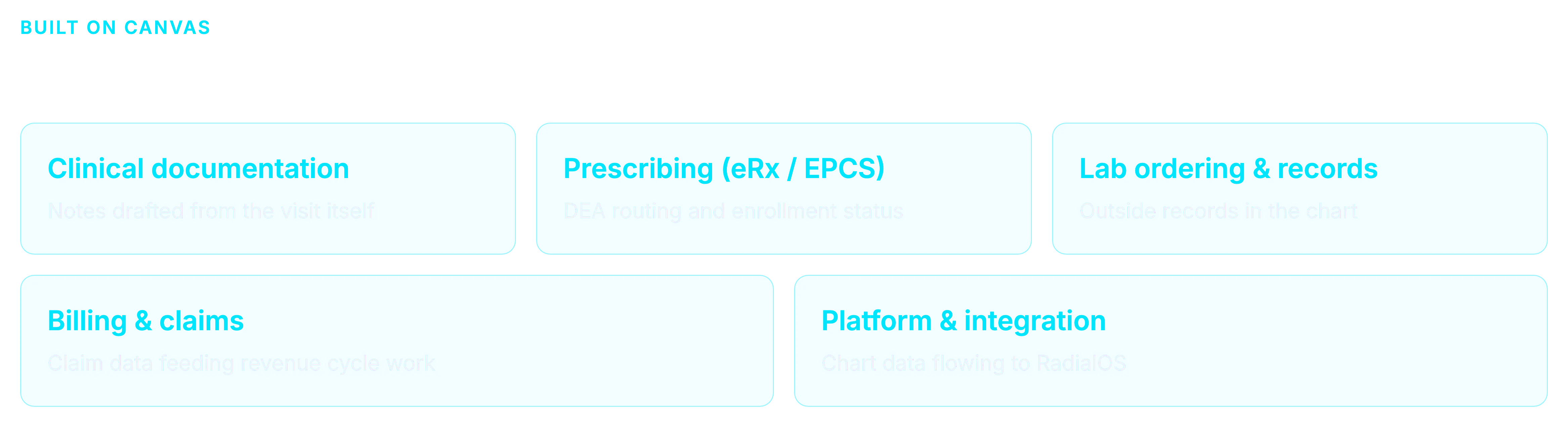
That architecture empowered Carlene to separate core EMR workflows from practice management. Patients interact directly with RadialOS, where Carlene controls the look, feel, and flow of the care journey for a seamless patient experience. For her team, that flexibility also means they can decide which workflows to build into RadialOS, which capabilities to rely on in Canvas, and when to extend the platform as the company’s care model evolves. Rather than spending a full development cycle on basic EMR capabilities, the team focuses on bespoke workflows. That has led them to save at least 6 months of dedicated focus from the product, engineering, and design teams.
Canvas's structured data architecture also gave Radial an early window into where clinical AI is heading. When Carlene’s team began using Hyperscribe, Canvas's AI documentation agent, they found that it used clinical context to draft prescriptions and lab orders directly within the encounter workflow, rather than just generating notes. That reliable automation means Radial's team can query Canvas's structured records directly, turning the patient chart from a documentation layer into a clinical data asset the company can actually build on.

Results
Owned Patient Experiences, Focused Engineering, and a Foundation for Future Growth
With Canvas, Radial has the EMR foundation needed to deliver interventional psychiatry at scale, without diverting engineering resources away from the specialized work that sets it apart.
- 6-week implementation completed alongside RadialOS development
- 9 plugins powering clinical documentation, prescribing, lab ordering, and billing
Looking ahead, Carlene is eager to lean further into Canvas as her team continues to build toward more conversational, agentic workflows that can query structured clinical data on demand.