Learn how this startup implemented Canvas as the technical foundation for a new kind of cancer care experience, one that prioritizes the patient journey, coordinates care between oncologists, providers, and caregivers, and brings support directly to patients in the home and virtually. The figures represent a patient population with multi-layered needs, and a care model built to match them.
- 7+ active conditions per patient managed across every care touchpoint
- 17+ clinical notes documented for patients with at least one visit
- 18 plugins powering risk scoring, care coordination, and patient history

About
Daymark Health is a cancer care startup that provides in-home and virtual supportive care for patients, working alongside the patient’s existing PCP and oncology team. Since its founding in 2024, Daymark has raised $31.5 million across several funding rounds led by Healthier Capital, Blue Venture Fund, Maverick Ventures, and Yosemite.
Challenge
Establishing a Robust Technology Foundation for a New Care Model
About two million people are diagnosed with cancer in the United States annually, and each one will spend over 8,500 hours per year outside the four walls of their oncology clinic. This leaves patients to manage questions, symptoms, and urgent needs on their own, leading to a fragmented care experience that gets in the way of their health.
Daymark launched in 2025 with a radically different care model, focused on bridging a system-wide gap and bringing support directly to patients. Built around home visits, virtual appointments, phone calls, and text messages, Daymark extends care into the 8,500 hours that patients spend well beyond the walls of any clinic, acting as a centralized support system that connects patients, their families, providers, and health plans.
Haylle Mandell, VP of Product at Daymark, knew that this unique vision required a sophisticated technology foundation that could help the company solve such a complex problem. After years at one of the largest EHR companies in the country, Haylle understood better than most what was at stake. The right EMR wouldn't just support Daymark's launch - it would determine how far this novel care model could scale. With only a few months to get it right and no dedicated engineering resources yet in place, the margin for error was slim.
Haylle wasn’t interested in an EMR that merely documented patient visits. Daymark's patients are often forced to navigate multiple conditions, complex medication histories, difficult-to-manage symptoms, and side effects, with care plans spanning many specialists. As such, the team needed workflows that could guide providers through cancer history, coexisting conditions, mental health assessments, and social determinants of health in a consistent way.
That complexity extended beyond the charts themselves. Daymark's model depends on close coordination across medical oncologists, primary care providers, nurses, social workers, and health partners, with patient relationships that often begin in the home before continuing across phone calls, virtual appointments, and text messages. Haylle needed a system that could capture context, coordinate follow-up, and maintain continuity across every modality without losing important information along the way.
Haylle and her team evaluated a wide range of options. Traditional EHRs offered familiar workflows, but gave Daymark less control over visit flow and less room to integrate the proprietary technology the company planned to build. More extensible platforms offered technical upside, but did not always support the clinical and operational complexity of oncology care.
Canvas stood out because it brought those requirements together—providing Daymark with a strong clinical foundation for complex oncology workflows, along with the SDK and API capabilities to build around the care model over time.

Solution
An AI-Powered EMR That Adapts to Complex Care Models From Day One
Getting started with Canvas was a swift and collaborative process. Haylle worked directly with the Canvas team to cover user setup, note templates, and workflow configurations well ahead of Daymark’s official launch. "We had an amazing onboarding team that walked us through every aspect of the setup in a very structured way," Haylle recalled.
In the early months, Canvas' no-code configuration tools gave Haylle everything she needed to build Daymark's core workflows without waiting on engineering resources. As Daymark's engineering team grows, Canvas grows with them. What once required months of custom development is now within reach through Canvas's SDK and plugin framework. In less than a year, Daymark's team had built 18 plugins spanning clinical, operational, and financial workflows.
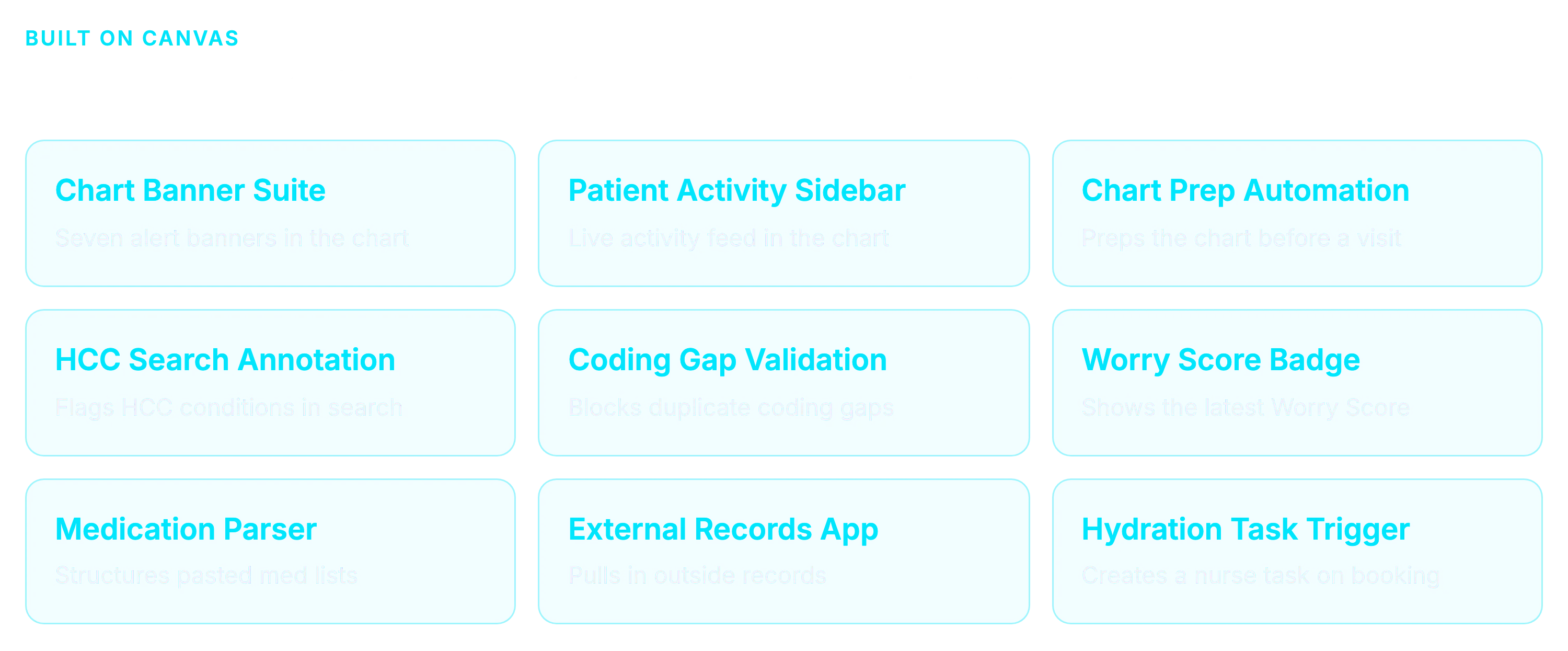
Between custom note templates to guide providers through new patient intake and questionnaires to capture structured data on topics such as advanced care planning, the impact was immediate.
"Some of what we've been able to configure would have required significant development resources anywhere else," Haylle noted. "Instead, we've been able to focus that time on our patients."
Today, Haylle uses Canvas to effortlessly orchestrate Daymark’s comprehensive, patient-first care model. Coordinated follow-ups ensure medical oncologists, primary care providers, nurses, social workers, and health partners have a shared way to manage multiple active diagnoses, high medication counts, and a steady volume of encounters. Reminders tied to treatment cadence, including follow-up check-ins after chemotherapy, help maintain continuity across home visits, virtual appointments, phone calls, and text messages. Now the interdisciplinary team has the infrastructure needed to manage this complexity without losing continuity across any care modality.
As Daymark's product and engineering team expanded, the Canvas SDK and open FHIR API provided the technical foundation for building more advanced workflows directly in the platform. They built a proprietary “risk score” plugin that uses structured clinical data from the chart to generate a score clinicians use to prioritize follow-up and outreach, then surface that score directly in the chart through custom action buttons.
Canvas' integration with Metriport also enabled Haylle's team to access prior medical records via a health information exchange. Now, the care team has more context earlier in the patient journey, prior medical records surface automatically, and medication histories are populated without manual entry, saving providers anywhere from 5 to 20 minutes per visit.
For Daymark, a fast-moving startup bringing a radically unique, patient-first care model to market, Canvas proved to be a key unlock.

Results
Seamless EMR Workflows That Scale Alongside the Company
With Canvas, Haylle established the EMR workflow foundation Daymark needed on day one. Now, she has a unified system to capture patient interactions across every care modality, coordinate follow-ups across the team, and support a complex patient population with the care they deserve at every step. Across thousands of patients with cancer, Haylle and her team have leveraged Canvas to provide always-on support customized to individual patient needs, ensuring patients and their families feel cared for and empowered throughout the cancer journey.
Looking ahead, Haylle is eager to use Canvas to support auto-generated tasks for clinical care gaps, earlier identification of high-risk patients, and the deployment of agentic workflows to automate manual work. The goal is to help Daymark turn clinical signals into timely action so the team can guide next steps with even more consistency.