The short answer: the best sleep medicine EMR is the one that fits how your practice actually screens, tests, and follows up. Sleep-specific EMRs come with deep content but you cannot reshape it, general EMRs are flexible but not built for sleep, and Canvas is a customizable sleep medicine EMR you reprogram to match your own workflow. This guide covers what to look for and how the options compare.
Sleep practices require specialized workflows that most EMRs weren't designed to support. You screen broadly with validated instruments, order and read home sleep tests, check benefits before care starts because CPAP coverage so often decides what happens next, then manage devices and adherence for months after diagnosis. An EMR either supports that workflow or forces workarounds - and eventually the workarounds become most of the job. This guide covers what a sleep practice actually needs, how available platforms compare, and the key questions to ask before you commit.
There are roughly four kinds of options:
- Sleep-specific EMRs come loaded with sleep content out of the box, from study templates to CPAP compliance to DME resupply. The catch is that the content is configured for you, not something you can reshape yourself.
- Sleep point solutions are good at one piece, scoring or diagnostics or resupply, and sit on top of whatever system of record you already run.
- General EMRs are broad and extensible, but were not built for sleep in particular.
- Canvas is a fourth kind: a working EMR that a practice reprograms to fit its own sleep workflow, using Studio and the Canvas SDK.
No two sleep practices operate in quite the same way, so the real question underneath all of this is whether the software can bend to how your practice works, or whether you end up bending to it.
What a sleep practice needs
Before comparing platforms, it helps to be clear on what the work actually demands. A sleep practice runs on a handful of capabilities, and an EMR that misses any of them pushes that work back onto staff:
- Automated intake that lands in the chart. New-patient intake maps into native records and locks as a structured note, instead of a stack of forms someone has to re-key.
- Validated screening, scored on arrival. STOP-BANG, Epworth (ESS), and the Insomnia Severity Index (ISI) compute at intake, so high-risk patients surface before the visit even opens.
- A pre-populated pre-visit note. Vitals including neck circumference, the HPI, risk flags, and the scored questionnaires are already in place when the clinician sits down.
- Eligibility and benefits verified up front. CPAP coverage often decides whether care can proceed, so it belongs at the start, not after the visit.
- Scheduling that routes to the right first consult. The patient books the correct visit type without staff playing traffic controller.
- CPAP and DME orders that move on their own. The device order flows to fulfillment and is tracked through to completion.
- Home sleep tests that come back as data. Apnea indices and Epworth trends live in the chart as structured values, not a PDF filed away.
- Longitudinal adherence tracking. Device use and repeat scoring are followed across months, not captured once and forgotten.
How the platforms compare
Where Canvas is different for sleep
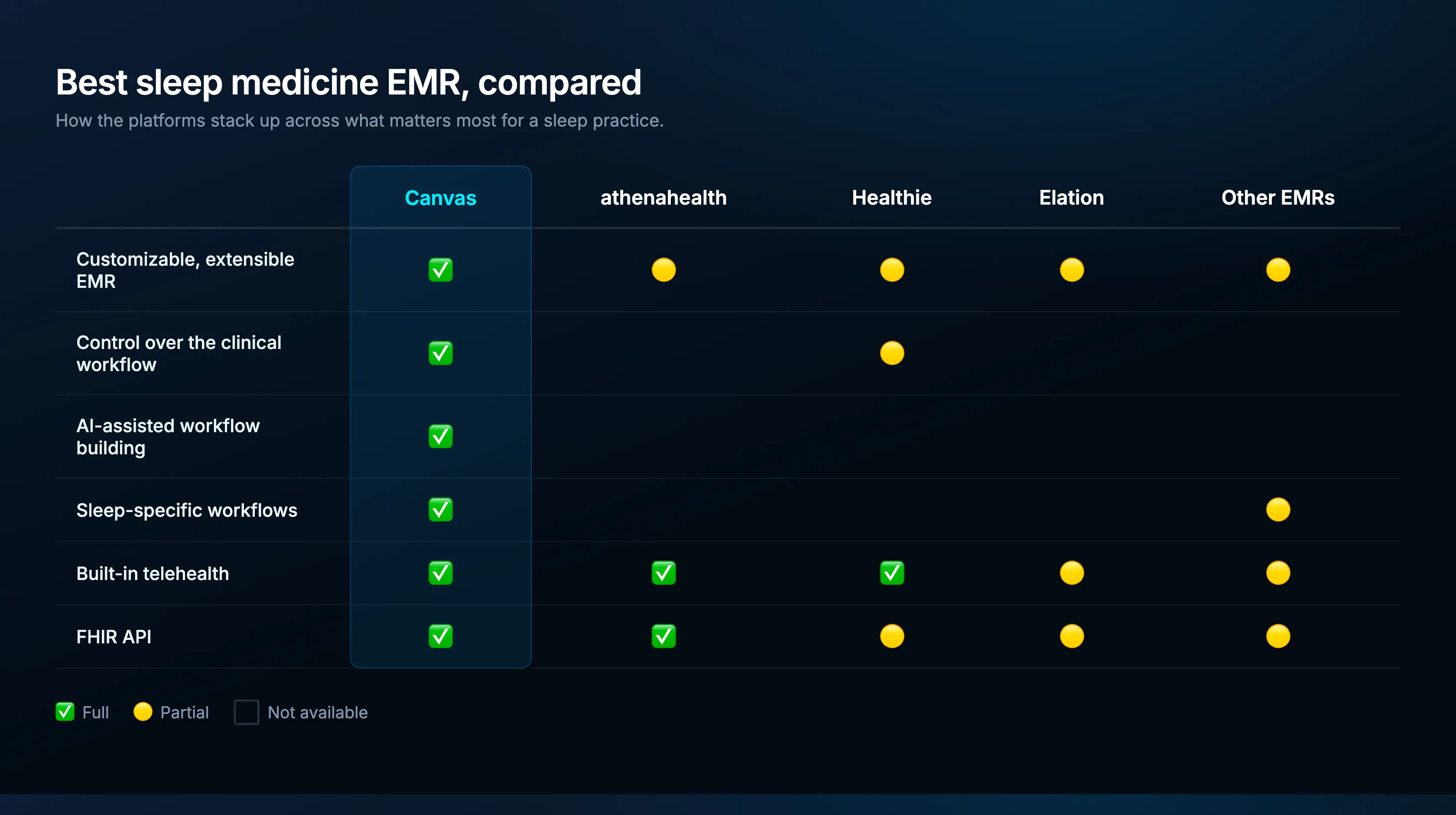
The table shows where each platform lands. Here is what the checkmarks mean for a sleep practice running on Canvas.
Customizable and extensible. A sleep practice's workflow is never quite like the next one's, so the software has to bend to it. Canvas is fully customizable: you extend and customize the actual clinical workflow, not a fixed core with an app layered around it. The sleep-specific and general EMRs can be configured within their own frameworks, but the framework is theirs, not yours.
Control over the clinical workflow. With Studio and the Canvas SDK you reprogram commands, questionnaires, and chart sections directly. That is the line between configuring what a vendor already built and changing how the chart itself behaves, and it is why Canvas is the only column with a full mark here.
AI-assisted workflow building. Describe the screening, the testing step, or the follow-up protocol you need in plain language, and an AI assistant in Studio builds it into a working plugin - no code, no developer, no engineering project on a timeline. When your care model or the guidelines change, you change the workflow yourself.
Sleep-specific, without the lock-in. STOP-BANG, Epworth, and ISI score at the point of care, and home sleep study results and Epworth trends live in the chart as structured data through the Sleep Study Visualizer plugin. The sleep-specific EMRs have deep content too, but theirs is closed. Canvas gives you the same depth in a system you can keep extending, and you can browse the full plugin library to see what is already built.
Built-in telehealth and FHIR-native data. So much of sleep care never needs an in-person visit, so telehealth is built into Canvas rather than integrated in later. And FHIR is how Canvas works, with a writable FHIR API, not a certification layer off to the side or an enterprise-tier add-on. Your data flows where you need it.
Usable on day one, built out as you go. Canvas is a working EMR the moment you log in, not a set of APIs and a build project. A clinician can run a real sleep visit right away, and the practice adds the pieces it needs over time with Studio, no engineering team required.
How to evaluate an EMR for sleep
When you sit down with any of these vendors, a few questions tend to separate the ones that will fit from the ones that will fight you:
- Do you get a working EMR on day one, or a toolkit to build one? Some of these are usable the moment you log in. Others are really a set of APIs and the expectation that you will build the rest.
- Can you change the actual workflow, or just the templates? There is a real difference between configuring what a vendor already built and reprogramming how the chart itself behaves.
- Who ends up doing that customizing? A no-code tool where you describe what you need and an AI assistant builds it is a very different commitment than an engineering project with a timeline.
- Is telehealth built in or bolted on? So much of sleep care never needs an in-person visit that this one is not optional.
- Can the sleep-specific work live in the chart as data? Scored screening, structured study results, CPAP and DME follow-up, all as real data rather than PDFs stapled to the record.
- Is the data FHIR-native, or is FHIR a gated add-on? With some platforms FHIR is a certification layer off to the side, not the way the product actually works. (Canvas covers the difference in HL7 vs FHIR.)
Build your own
The practices that get the most out of their EMR are usually the ones that made it their own. That is what Studio is for: describe the screening, the testing step, or the follow-up protocol your practice needs, and you get a working plugin back without standing up an engineering project to do it. If you want to go deeper, read the full sleep medicine guide, explore the sleep medicine EMR and the other specialty EMRs, or talk to Canvas about how a sleep practice would run on the platform. Or just run the sleep medicine trial EMR and see how it feels.