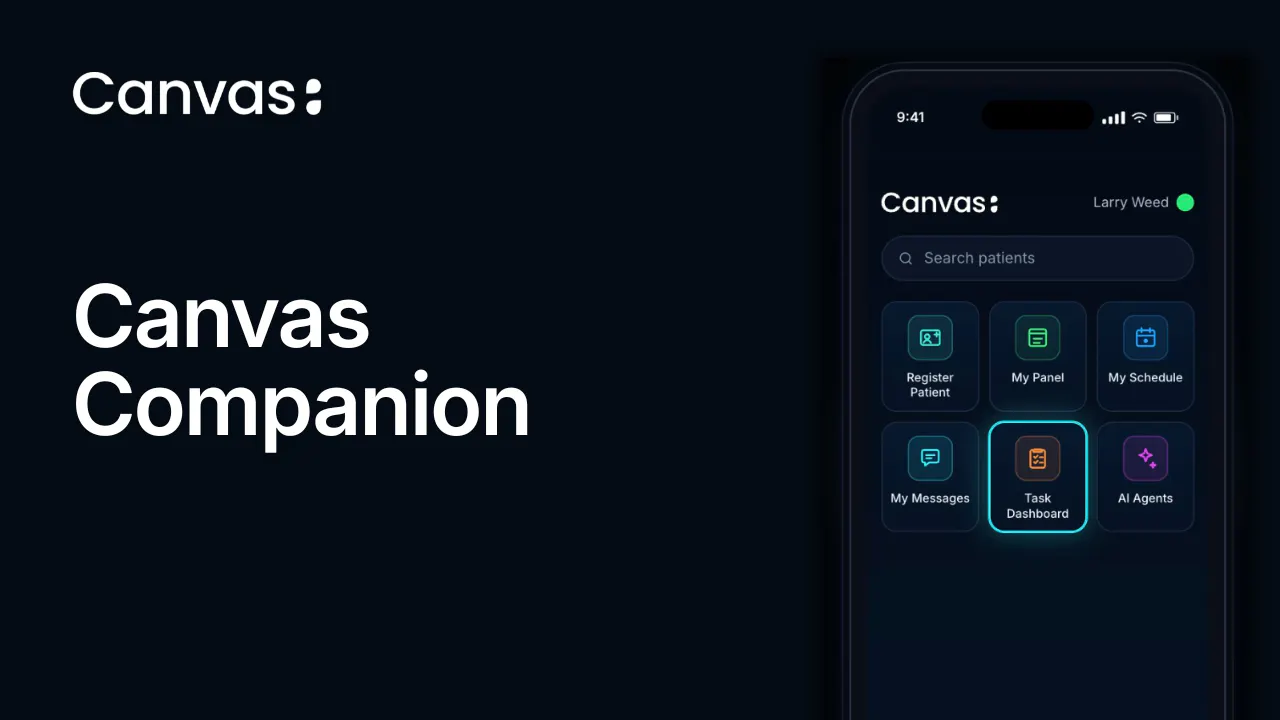
Here in the year 2026, we know that care is not delivered exclusively in 5 story medical office complexes. Providers meet their patients wherever they are, whether that's in an office, through a video call, in the patient's room at an assisted care facility, or in a mobile care van in a parking lot. In some situations a laptop is too much to juggle, too much of a hassle, or too much of a distraction. For those moments we're offering providers an alternative: the Canvas Companion.
The Canvas Companion is an open ended mobile EMR experience, designed to be tailored to your exact workflows. With the Companion you can perform tasks as simple as viewing today's appointments or as complex as documenting an encounter with the help of an ambient scribe.
It's been 20 years since the launch of the iPhone, and mobile experiences aren't novel anymore. The Canvas Companion isn't interesting or exciting just because it's mobile friendly. It's useful for sure, but it is not a world-changing feature. The reason the Canvas Companion is important is because the design philosophy represents a major change in how we build and deliver our software. Rather than being limited by a set of features we've deemed important to mobile care scenarios, you have the ability to choose a tailored experience by installing the plugins relevant to your needs.
The Canvas Companion is a three-tiered experience with very few features baked in. The actual useful bits are provided by plugins, which are built with the Canvas SDK. Each of the three tiers provides a context to the plugins executed within them.
At the top level you have system-wide applications. These might be a list of your upcoming appointments, a unified messaging application where you can respond to patients, or a task dashboard.
Using the search feature, you can visit a specific patient's chart. This is the second tier, and applications here are launched within that patient's context. If you opened that same task dashboard at this level, you would only see the tasks associated with the selected patient. In addition to tasking, an example application at this level could be a visualization of vital sign trends.
These applications are applicable to a patient, but not a specific encounter with that patient. That's the third and final tier. By choosing an encounter in the patient's timeline, you can view any information that has already been captured, or you can launch an application to document the encounter. A generalized clinical documentation interface on a mobile phone sounds miserable, but one customized for your visits can be streamlined for quick, consistent, and standardized data capture. You can complete your note on the spot or finish up with your laptop.
Here’s the best part about Canvas
Companion: you don't need to build anything before using it. To ensure the Canvas Companion is useful by default, we've developed a series of reference plugins which provide key functionality from the jump, and we'll be constantly adding to the library of turn-key features you can install. If you'd like to build your own, check out our SDK documentation site or install our Claude Code plugin and let it know you want to build a Canvas Companion plugin application. If you build something great, you can choose to keep it private or contribute it to the open source library of publicly available plugins.
Canvas as a Harness for Plugins
The design of the Canvas Companion represents our strategy for significantly scaling the variety of experiences possible in Canvas. We have built a platform that empowers everyone (not just software engineers!) to customize and extend Canvas. The cost to build software has never been lower and the barriers have disappeared entirely.
Today, not all Canvas employees are software engineers but every Canvas employee builds plugins. We believe the compartmentalization and strong interfaces our tools provide are key to responsibly allowing massive parallel contributions from both technical and non-technical builders alike. In order for this to be successful, we separate the platform from the features delivered through it.
The Canvas platform's purpose is to provide the context and hooks for running plugins. Plugins are not on top of or in addition to Canvas, plugins ARE Canvas. Whether built by us or by you, plugins are first-class citizens in our architecture. We build using the same tools as you. We have the same capabilities as you. Nothing more, nothing less.
If you're ready to start building in the EMR instead of building on top of it, check out our reference plugins, our docs, our coding agents, our trial instances, and our developer community, and lets create the medical software that can only exist with full access to the EMR runtime.