The first Canvas BUILD Summit kicks off this morning in San Francisco. We’re making the Presidio Log Cabin our fertile ground for innovation and exploration. Fifty builders, clinicians, and engineers - an exclusive group of invited customers, partners, and the Canvas team - are spending the day building healthcare software together.
This isn't a conference. There are no keynotes, no booths, and certainly no vendor pitches. Everyone in the room is here to build something and deploy it before the clock strikes happy hour.
We'll be updating this post throughout the day. Check back in for live dispatches from Build.
Hear about BUILD from our CEO Adam Farren
9 AM Welcome
Clients started congregating at The Log Cabin at the Presidio.
Canvas team members are on hand to help anyone finishing setup for the two workshop tracks: CPA, which runs in the command line using Claude Code and the Canvas Plugin Assistant, and Studio, Canvas's new in-product coding agent that runs entirely in the browser.
9:15 AM Fireside Chat
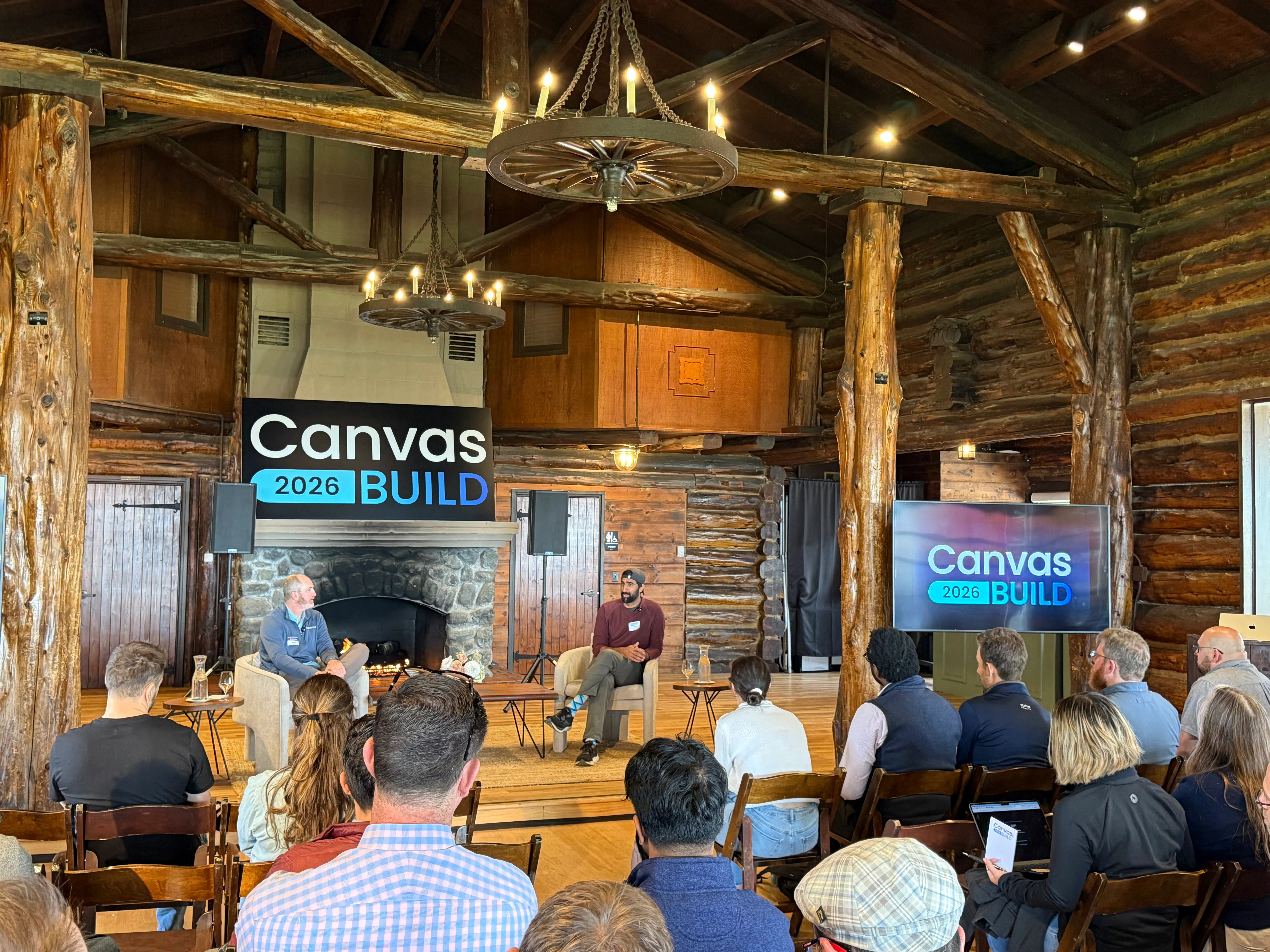
Arif Sorathia Founder of Practice with Joy, and an Investor at Route 66 Ventures, in conversation with CEO Adam.
“We’re starting to see clinicians wanting not to be clinicians anymore. Now is the opportunity .. Practice with Joy is basically building the full practice-enabled tech system for high-quality care,” says Arif.
“We looked at all of the players out there. What became very clear is a full, headless EMR form scratch is a bunch of commodity work. Canvas is the only place where you can build something purely bespoke, but not having to build everything from scratch. That was our initial pick on Canvas relative to all our other players.”
You’re actually running the entire clinical visit with a bespoke AI inside Canvas. “There’s no other place where you can do it.”
Arif asserts there should be more collaboration in the healthcare startup ecosystem- all healthcare startups are essentially up against the mega hospital industrial complex.
Wearing his investor hat, he pontificates - “In five years, would you rather be in a services business with 40% margins or software business with 60% margins?” (The answer is obvious).
Arif invested in Canvas a year ago from Route 66 Ventures. “More bullish now than we were at time of investment. We see more of a future where you can build a bespoke EMR without hiring the manpower to build it.”
In response to Adam’s question, “What should I be thinking about right now? Arif says: “Healthcare is hard. The more you can build the things that nobody in this room wants to build, you’ll build a much more durable business. Value is accrued with the really hard things.”
9:30 AM Canvas Studio launches!
Canvas Studio is a new in-product coding agent built on Anthropic's Claude Code, that lets anyone describe a plugin in plain language and have working code generated inside Canvas. There’s no command line and no dev environment setup necessary. The steps?
- You describe what you want to build
- Studio writes it
- You deploy it
“All the power, with all the simplicity,” says Andrew Hines, founder & CTO of Canvas. “This software is going to lead us into this era of abundance.”
9:45 AM Big Announcement #2: Navigator
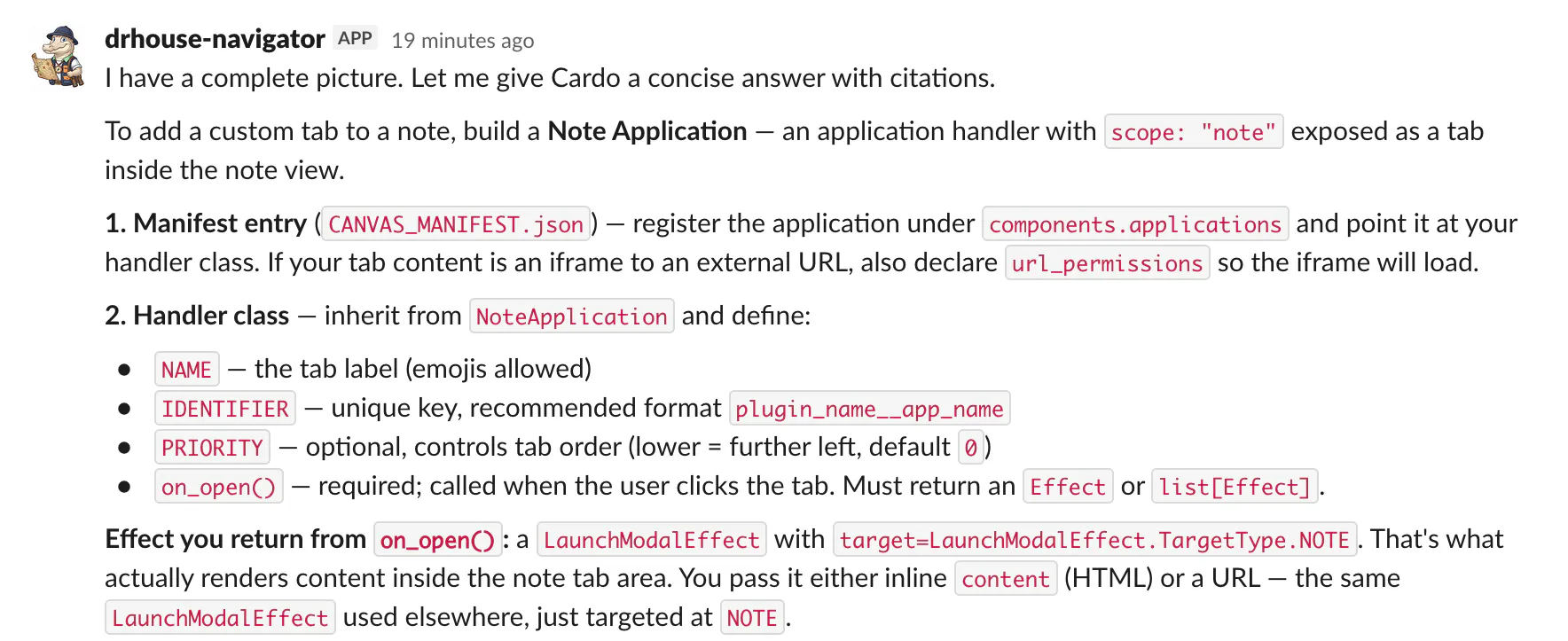
We launched another tool that we’ve been developing internally. Chief Engineering Officer Beau Gunderson debuts NAVIGATOR, Canvas’s support Slack agent, that redefines the way we work at Canvas. which is now in all of our clients’ Slack channels. Given the infinite demand and finite support, it’s clear the support team is swamped, and Navigator is the solution.
Powered by Claude Code and embedded in our Slack channels, it uses MCPs and APIs to pull context from Jira, Sentry, Elastic, Notion, and our codebase to help us investigate everything from customer education to code archaeology.
Navigator launches June 1. If you're already in a Canvas Slack channel, you'll see it show up. Ask it to introduce itself and explain how it can help. If you have other requests, tell it that too - that's how it will continue to get better.
10 AM-12:30 PM BUILD Mode
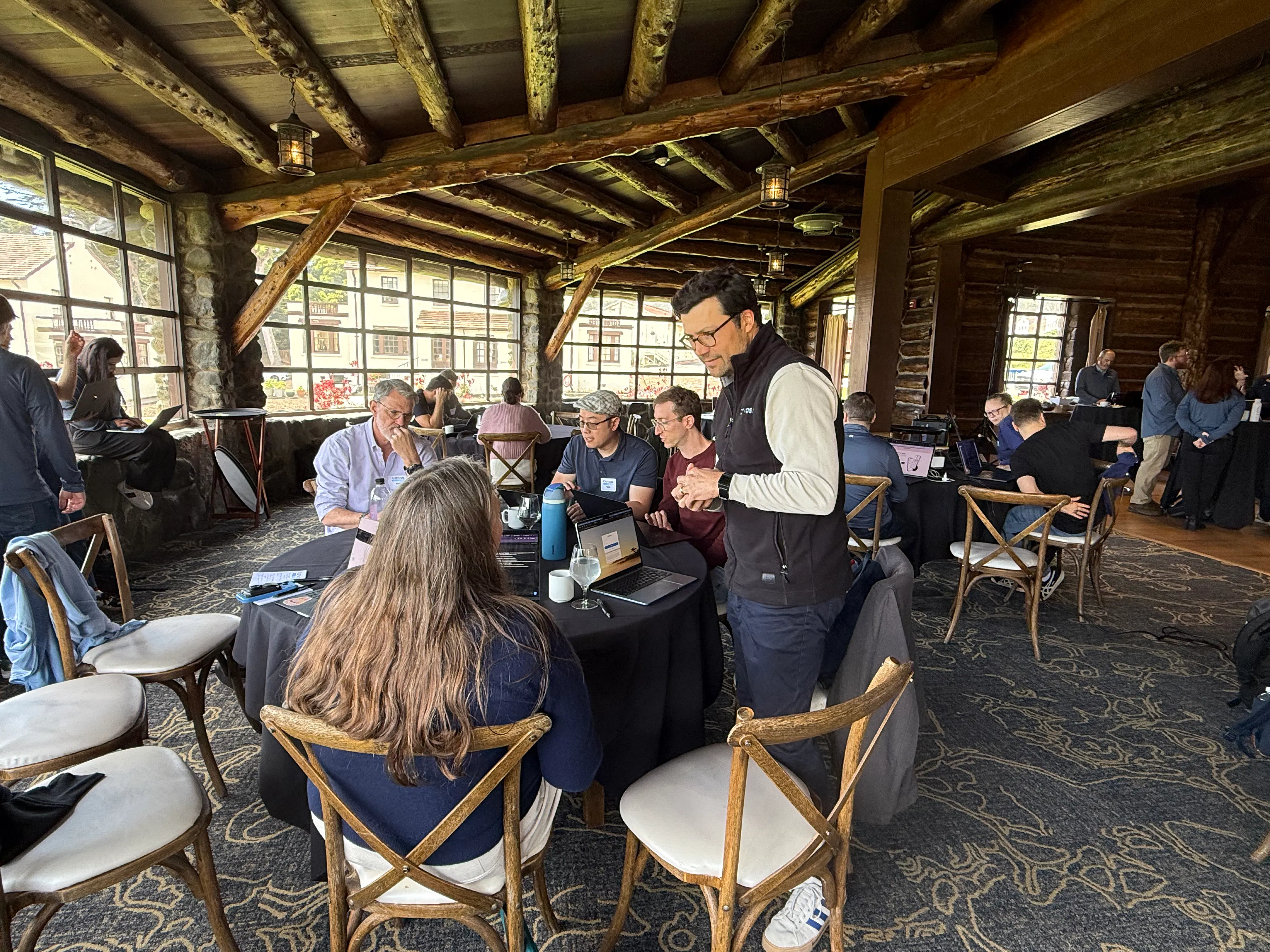
🏃🏻♀️ The workshop is now underway. Both tracks - CPA and Studio - are running simultaneously in breakout spaces. The Canvas team is embedded at every table.
The problem-solving energy inside the Log Cabin is electric.
Canvas engineers are embedded at every table, working through real problems alongside customers. The advice from the floor: start small and build from there. Studio is more capable than it first appears - keep pushing and prodding it, and it will get you further than you expect.
The range of what's being built is striking: dashboards, patient chart widgets, and custom clinical note structures, to name a few. Problems range from quick workflow fixes to deep, complex healthcare challenges. Alexia Downs, Canvas’s AI Operations lead, is stress-testing how far a tool can get in a single day - including one group taking on prior authorizations, one of the most notoriously tangled workflows in medicine.
One of the most compelling conversations happening right now is around reporting. A team described a painfully familiar dynamic: any time someone in the organization needs data, the request goes to engineering. Engineering writes the queries, sets up the dashboard, and then supports it indefinitely. The billing team alone generates a constant back-and-forth.
Canvas customer and DrHouse lead engineer Cardo Uustal has a goal today: build a plugin so the billing team can pull their own reports by describing what they need in plain speak. No engineering ticket. No wait. No back-and-forth.
That's exactly the kind of idea Studio was built for.
1:15 PM Fireside Chat
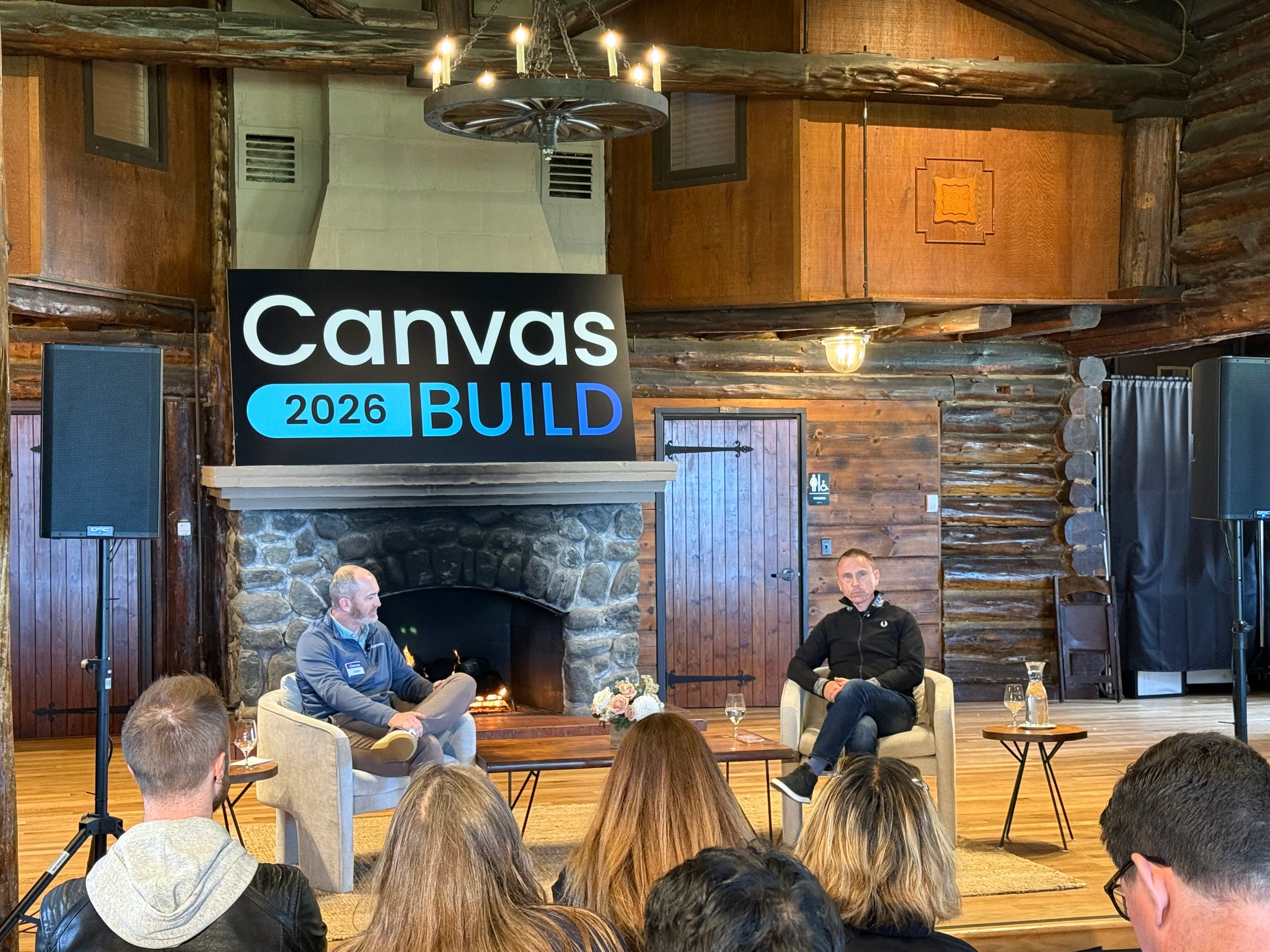
Simon Williams has implemented Canvas at three different healthcare companies. He keeps choosing it, even with very distinct use cases. He joins Adam for an illuminating fireside chat.
Simon has a storied career in startups, but first came to healthcare in 2015 and has since worked across Lemonaid Health, Patina, Synapticure, and currently Wisp, where he started as an advisor in 2024 and joined full-time as CTO in January 2026. He is, by his own description, a Chief Trade-off Officer.
"Having something that's super flexible is key to growth. Canvas works right out of the box, and then you can start tinkering with it. You can embark on your journey and make changes as you go."
Each company he has brought Canvas into has used it differently. At Patina, a value-based care organization, his team was among the earliest users of the SDK and plugins, using them to standardize care delivery and drive down medical loss ratio. At Synapticure, the focus was on pulling comprehensive medication history. At Wisp, a high-volume telehealth practice processing 5,000 orders a day, the priority is speed and efficiency. Controlling the user experience, he says, is a non-negotiable at that scale.
Simon’s advice when he started advising Wisp in 2024 was actually to not change EMRs. But by early 2025, the decision was made. "When you have limited resources, building plumbing is not a differentiator." Canvas sits in the middle: use it, tweak it, move on.
He saved the best (and most recent) story for last. He woke up in a cold sweat the night before the summit, worried about a subscription workflow. Patients on a five-fill prescription need to check back in and renew before their next fill. His head of engineering asked Canvas Studio if it could handle that more efficiently. It could. "I slept better last night than I did the night before," he said.
On what he sees as the most interesting opportunity ahead: the ability to enforce clinical standards at the point of care. A checklist for providers, specific to each patient's history and reason for visit. Essentially a copilot, not a replacement.
His parting words of advice? "Don't let perfection be the enemy of good. I've seen so many companies feel like something needs to be launched a certain way. But if you start, you learn. Do something. Smart."
Adam's response from the audience landed just as well: "The value of a perfect plan has never been lower. Let's just start. Let's just build." Right on theme for the day.
1:30 PM-3:30 PM Workshop Phase 2! Deploy.
The afternoon session is focused on deployment. Teams are moving from working code to live Canvas instances - testing with sandbox patient data, iterating based on what breaks, and refining their ideas.
All attendees were heads down in collaboration mode, tapping the Canvas team for troubleshooting and support as needed. But it’s truly incredible to see Studio work its magic. Here’s a snapshot of the plug-ins that clients built using Studio as their copilot and with ~$3K in Claude tokens. All of this happened over the course of a short five hours. What would previously take days, weeks, or months.
It's a snapshot of clinical, financial and operational automations across a full spectrum of outpatient care represented in the Canvas customer base.
And it's a signal of the power of the Canvas platform and the new Studio interface. You bring your domain expertise, we bring the SDK, and the agent makes it real.
Some highlights:
- CKD patient ingestion, CHF tier-1 enrollment, and a pre-visit summary card for a value-based kidney care model.
- FDA food and medication recall alerts on affected charts, provider state licensure tracking, and an internal knowledge base for nutrition medicine.
- A Connective Health registry dashboard for ALS patients, alongside a medication reconciliation workflow for dementia care.
- Prior-authorization letters from chart context and automated outreach waves to close open care gaps for NP-driven primary care.
3:45-4 PM Fireside Chat
Miranda Zhao, Product at Sierra in conversation with Canvas CPO JP Patil
Miranda Zhao builds AI agents at Sierra. Her perspective on the agent landscape frames how to think about what is getting built today.
At Sierra, agent development happens in two stages: testing and simulation. Before anything goes live, teams build automated simulations that run scenarios against the agent repeatedly, building confidence in how it will perform across different users and edge cases. "It's an iterative process," she said. "Agent hill climbing."
In healthcare specifically, the evaluation framework comes down to three things:
- Did the agent accomplish the task?
- How satisfied was the customer?
- What is the quality of the agent's responses?
Guardrails are non-negotiable. Sierra's agents are designed to stay in bounds, which in healthcare means never offering medical advice. The team runs LLM-powered monitors on conversations continuously, flagging anything out of bounds in real time. Containment, she said, is the core measurement.
Zhao came to Sierra from Google Search, where the pace of change was measured in quarters. At Sierra, it’s measured in days: the sign-up process is simpler, the iteration cycles are faster, and the gap between idea and deployment is shrinking fast. The Canvas BUILD Summit is evidence of exactly that.
She closed with a note that was equal parts product wisdom and reality check: “the tools are easy now. Vibe coding makes everything easy.” But the thing that still has to be right is the thing that was always hard: figuring out what problem you are actually trying to solve, and validating that it is the right one before you build.
It’s traditional product advice.
4-5 PM Show and Tell
Demos: Clients showed what they’ve built today. Here are a few plug-ins they built.
Select groups demo what they’ve built today…running directly in Canvas! Lots of nodding and oohs and aahs. Here are a few of the plugins built today:
Blue Circle Health
Endo_np_template - A note template built specifically for endocrinology nurse practitioners to standardize how visit documentation gets written.
Chronius Health
running_late_to_visit - A visit-readiness signal that flags when a provider is falling behind on their daily schedule.
Cylinder
patient_caption_banners - Renders contextual banners at the top of the patient chart showing program, cohort, and alert information.
Duo Health
charting_ui - Custom charting UI extensions tailored to Duo's value-based primary care workflow.
Goldenscript
medication_history - Pulls external pharmacy and PBM medication history and surfaces it directly inside the chart.
Icon Health
data_integration_auto_routing - Automatically routes inbound integration messages to the correct downstream handler or queue.
Practice With Joy
prior_auth_letter - Generates a prior-authorization letter pre-populated with context from the current chart.
Rivia Mind
intake_dashboard - A new-patient intake operations dashboard built for psychiatry and behavioral health onboarding.
Strive
network_referrals - Manages referrals across Strive's partner and clinician network.
Sylvan Health
state_licensure - Tracks provider state licensure status, board information, and expiry dates.
Synapticure
daily_summary - A daily clinical-activity digest designed for care-team huddles.
Vida Health
rd_workflows - A Registered Dietitian workflow plugin powering Vida's RD-led nutrition and GLP-1 member care programs.
Vineyard
weight_graph - Visualizes patient weight trajectory over time for GLP-1 and weight-management patient cohorts.
Wisp
lp_refills - A landing-page refill flow for telehealth prescription renewals.
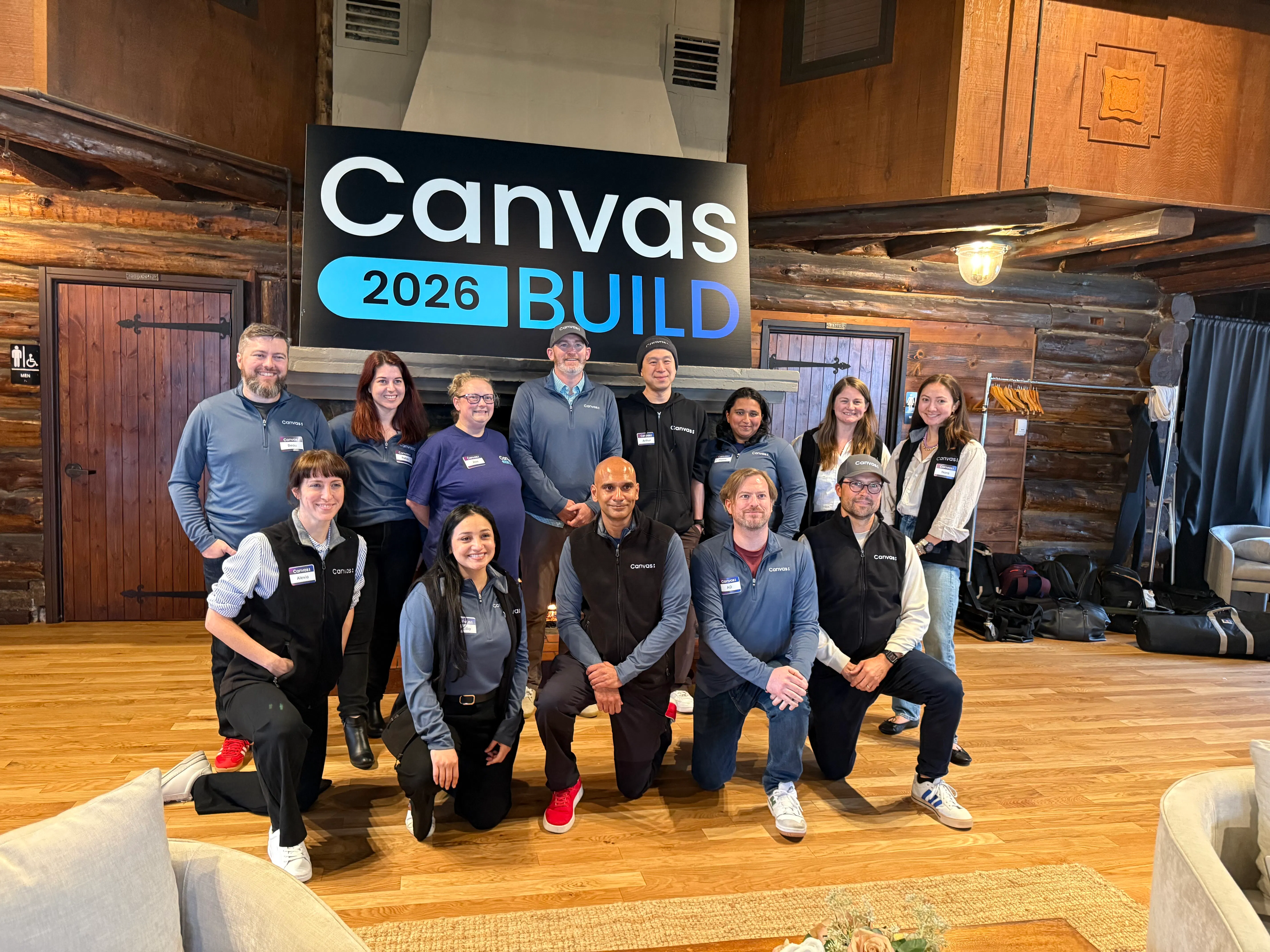
💥 Today marked a momentous first BUILD - 32 plugins, 14 customers, and a glimpse of what happens when clinical teams get the tools to build exactly what their patients need. We’re excited to see Studio unlock more brilliant ideas.